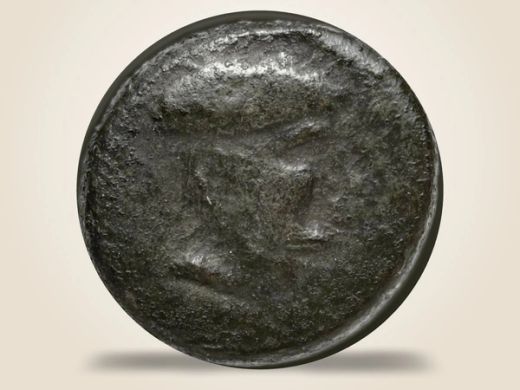
Follaro of Ulcinj — the Virgin and the Lamb of God
Ulcinjski folar — Bogorodica i Božije jagnje
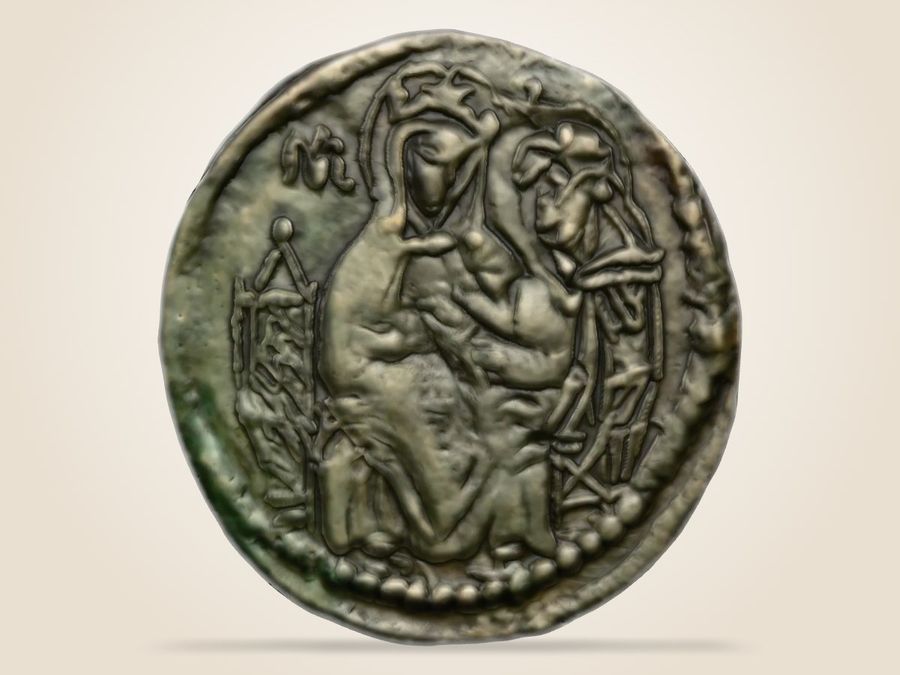
Drag to rotate · pinch to zoom
loads {mb} MBDescription
The follaro of Ulcinj is the **medieval civic coinage of Ulcinj (Dulcino)**: small change of copper or copper alloy for payments in local trade, struck by hand. The obverse shows **the Virgin enthroned** holding the Christ Child; the reverse shows **the Lamb of God with halo** and cross.
The catalogued legend AGNVS DEI means “Lamb of God”, and M D DVLCINO abbreviates **Moneta de Dulcino — “coin of Ulcinj”**. This is the catalogue reading: the full legend is not reliably legible on the photographed specimen. Follari with the lamb are dated to the **14th century**; Sergije Dimitrijević places them from the beginning of the century to the 1370s. The exact year of striking of the specimen shown is not known.
Ulcinj was then a coastal commune with a degree of self-government and its own statute, in which copper follari were struck. The Lexicon of the Archaeology of Montenegro describes exactly this type: the Most Holy Virgin on the obverse, the Lamb of God with halo and cross on the reverse. [1] The rulers of Zeta **Đurađ II Stracimirović Balšić** and **Balša III** also struck coins in Ulcinj and Bar, and under Venice follari with St Mark on the reverse were struck in Ulcinj. [2]
The 3D model was made after photographs of a specimen of this type: obverse and reverse were modelled separately, in full relief, and joined into a two-sided coin. The model is a faithful three-dimensional rendering of the type, not a measured survey of the specimen; the mass of the model matches the published specimen (0.77 g), so the relief is lower than on the other coin models in the collection. For 3D printing, obverse and reverse were prepared as separate models.
Literature and sources
- Centralna banka Crne Gore, Muzej novca: „Novac u Crnoj Gori kroz istoriju“ — https://www.cbcg.me/me/novac/muzej-novca/novac-u-crnoj-gori-kroz-istoriju
- M. Kirsanov, „Novac gradova u doba Balšića“, Bankar 37 (2017), str. 89–90 — https://ubcg.info/wp-content/uploads/2017/04/BANKAR_Broj37_2017-04_WEB.pdf
- Numista N#196090, Dobrinić 1.1.3.1 — https://en.numista.com/196090
- M. Odak, Istorijski zapisi 3–4/2022, str. 39–40 — https://istorijskizapisi.me/wp-content/uploads/2024/01/2.-Marina-Odak.pdf
- CANU, Leksikon arheologije Crne Gore, odrednica „Ulcinj“ (M. Vrzić, A. Ljuljđuraj) — https://leks.canu.ac.me/web/arhcg.php?OID=7115
- CANU, Leksikon arheologije Crne Gore: „Numizmatika“ — https://leks.canu.ac.me/web/arhcg.php?OID=6909
- CANU, Leksikon crnogorskih dinastija, odrednica „Novac Balšića“ (Z. Deletić) — https://leks.canu.ac.me/web/lcd.php?OID=5588
From the same collection
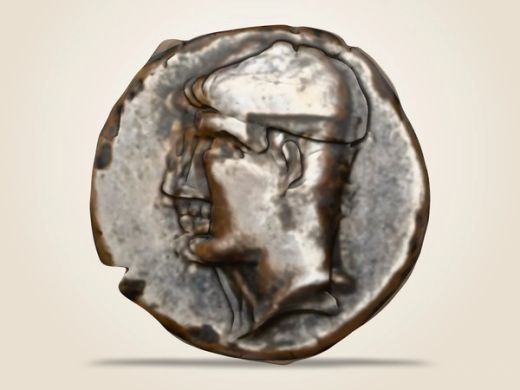
Coin of King Ballaios — Artemis with a torch
3rd century BC (c. 260/250–230) or 2nd century BC (after 168); dating disputed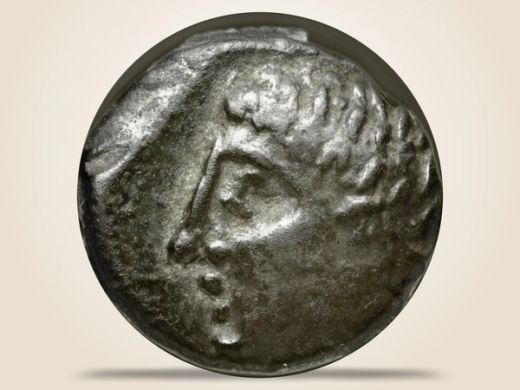
Coin of King Ballaios — Rhizon type (Risan mint)
2nd century BC, 167–135 per BnF; mid-3rd century BC per the Lexicon of the Archaeology of Montenegro (dating disputed)