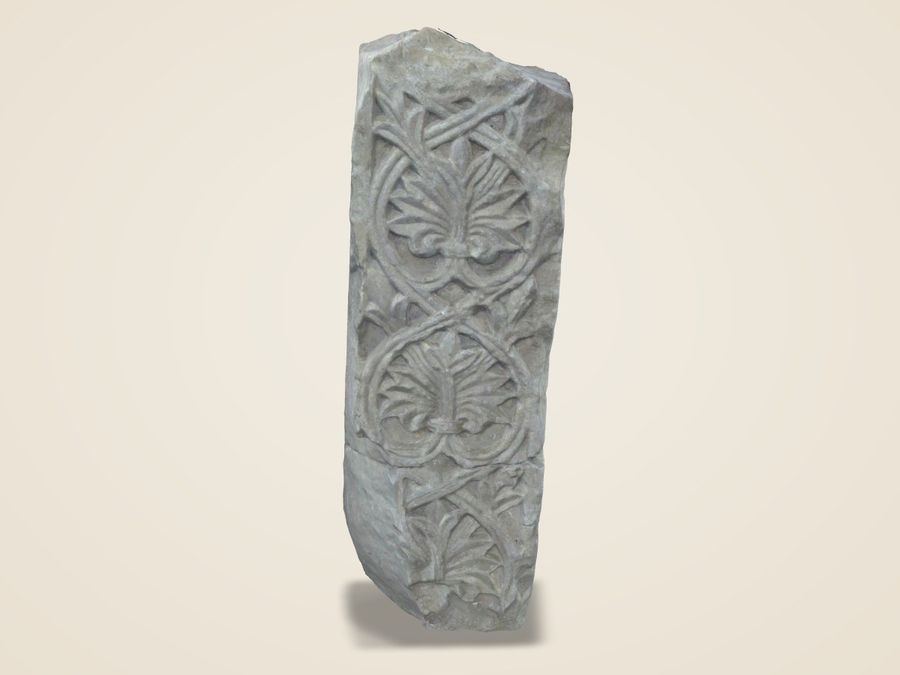
Fragment of a decorative doorframe
Ulomak dekorativnog okvira vrata
Drag to rotate · pinch to zoom
loads {mb} MBDescription
A 13th-century fragment of a stone doorframe, decorated with a frieze in deep relief: **a row of circles formed by an interlaced tendril**, each enclosing a **palmette**, a fan of leaves whose stem is bound with a ring. Leaves fill the spaces between the circles, and the background is deeply undercut. Pavle Mijović published it as a “fragment of the decorative doorframe, XIIIth century”. [1] The Museum records the object under the working name **“Shtylla me dekor”** (decorated pillar).
## What it was for
A doorframe surrounded the entrance to a building: two doorposts at the sides and a lintel above them. Mijović writes that the remains of the churches of Ulcinj recorded from the 13th century onwards show they were “finely built of dressed stone ashlars laid in courses, with doors with profiled pilasters and doorposts, with rosettes and friezes of arcades or sculptures on the façade”. [2] For Romanesque buildings, he says, the people of Ulcinj made door and window frames from the stone blocks of the old Cyclopean wall; whether this stone is one of them has not been established. [3]
## Ulcinj in the 13th century
From the 13th century onwards the sources mention many churches in Ulcinj: the principal one, of the Virgin (*Sancta Maria mater ecclesiae*), and the church of St John of Ulcinj (1290); Queen Helen of Anjou and her sister Maria founded a Franciscan monastery in the town in 1288. Ulcinj was then one of the most important coastal trading centres of the Serbian state and a frequent residence of rulers: in 1252 Đorđe, son of King Vukan of Zeta, held court here as “princeps Diocliae”, and from 1281 Maria lived here as “domina Ulcinii”. [4]
Of these churches what is known today is their mention in written sources, foundations excavated in the Old Town and fragments of carved stone found in the ruins. This doorframe is one of the few such fragments that Mijović published in his guide with a photograph and a date.
## How the stone stood
In Mijović's photograph the stone lies horizontally, so the palmettes in the circles lie on their sides. They all face the same way, with the ring-bound stem at the same end of the stone. When the stone is set upright with that end down, the palmettes stand upright — which is why the model is shown upright here, as part of a **doorpost**. This is a conclusion drawn from the direction of the ornament, not a statement from the literature; a horizontal position, on a lintel, is not excluded. [5]
## The fragment in the literature
Mijović published the stone in his guide to Ulcinj, in the English edition of 1977 and the third edition of 1985. Describing the museum display, he lists it among the stone fragments arranged along the walls — “the doorframe from the XIIIth century” — together with capitals and columns from the cathedral and other churches of the 13th to 16th centuries. [6] The date is Mijović's and is not argued in the guide; the findspot, the building the stone came from and its inventory number are not recorded.
In Mijović's photograph the stone shows two complete circles. Today a third fragment, with a partly preserved circle, is joined to it; on the upright model it is the lower part. The join is visible on the model, and the change is not recorded in the published literature. [7]
## Replica
From the 3D scan a **full-size replica** can be made, in stone or as a cast, and set upright as a doorpost. The whole doorframe could only be added as an assumption: only this fragment survives, and the appearance of the rest of the doorpost, of the lintel and of the building the door belonged to is not known, so any such completion would have to remain marked on the replica. [8]
## 3D scan
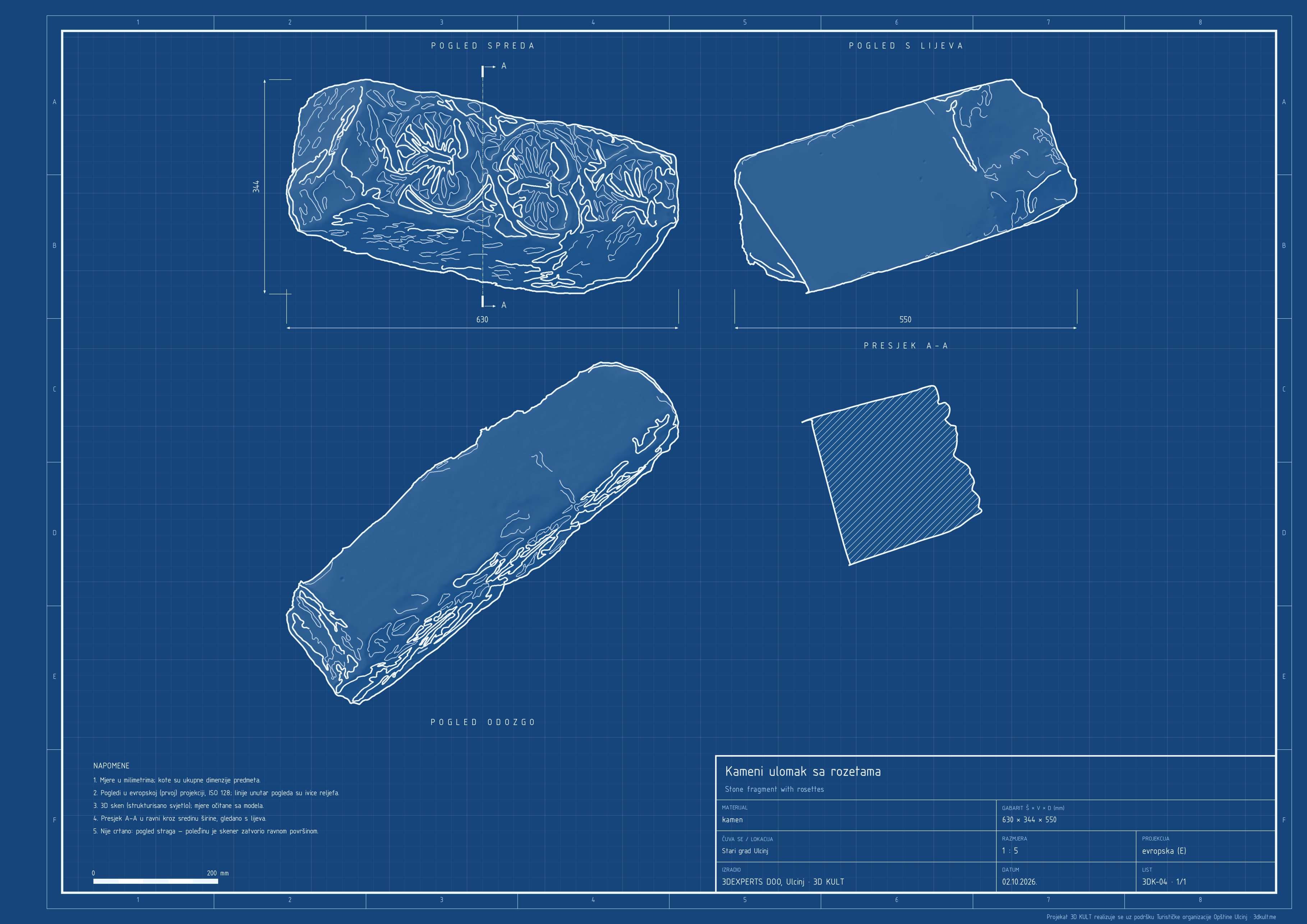
The object was recorded by contact-free 3D scanning. The source model has **400,000 triangles**, with an average triangle edge of about **1.87 mm**: the finest measure of shape the model retains. The surface colour was captured in an 8,192 × 8,192 pixel texture, about 6.3 pixels per millimetre of surface. The mesh is not closed, as part of the surface was not recorded, so the surface area, 6,042.5 cm², was measured but the volume was not. For the web the model was reduced to 150,000 triangles and a 2,048-pixel texture; the source scan is kept for documentation, technical drawings and printing replicas.
The decorated face and the sides were scanned; the back and one side were not recorded. In those places the model has a flat surface with a neutral stone texture, without any detail — **nothing has been filled in with invented geometry**. The dimensions therefore refer to the scanned part, not to the whole stone.
Technical drawing
 Open PDF (A3) ↓
Literature and sources
- P. Mijović, Ulcinj — Guide through its History and Culture, Guides 1, Ulcinj: Museum Olcinium, 1977, str. 22 (fotografija: „Museum Olcinium, fragment of the decorative doorframe, XIIIth century“), str. 14, 16 i 27.
- P. Mijović, Ulcinj: istorijsko-umjetnički vodič, 3. izd., Vodiči 1, Ulcinj: Muzej Ulcinj, 1985, str. 22 (fotografija: „Muzej Ulcinj, fragment dekorativne vratnice, XIII vijek“), str. 14, 16 i 28.
From the same collection
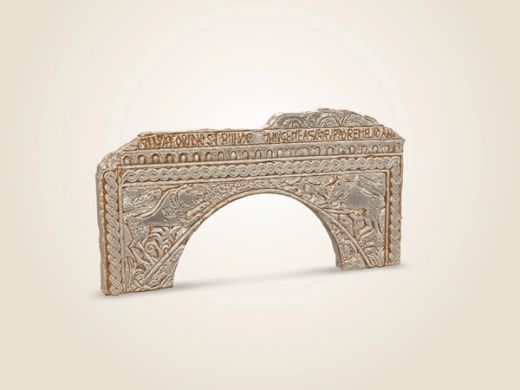
Fragment of the Ulcinj ciborium
Pre-Romanesque, 9th century: 813–820 (by the emperors named in the inscription)
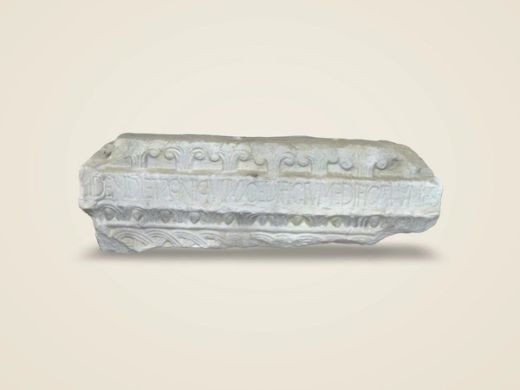
IHS plaque with lions
Venetian period, 15th–16th century (Ulcinj under Venice 1421–1571)