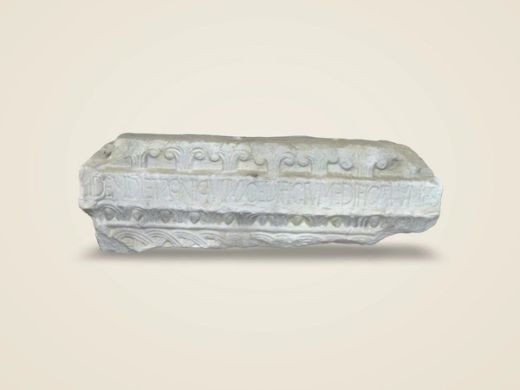
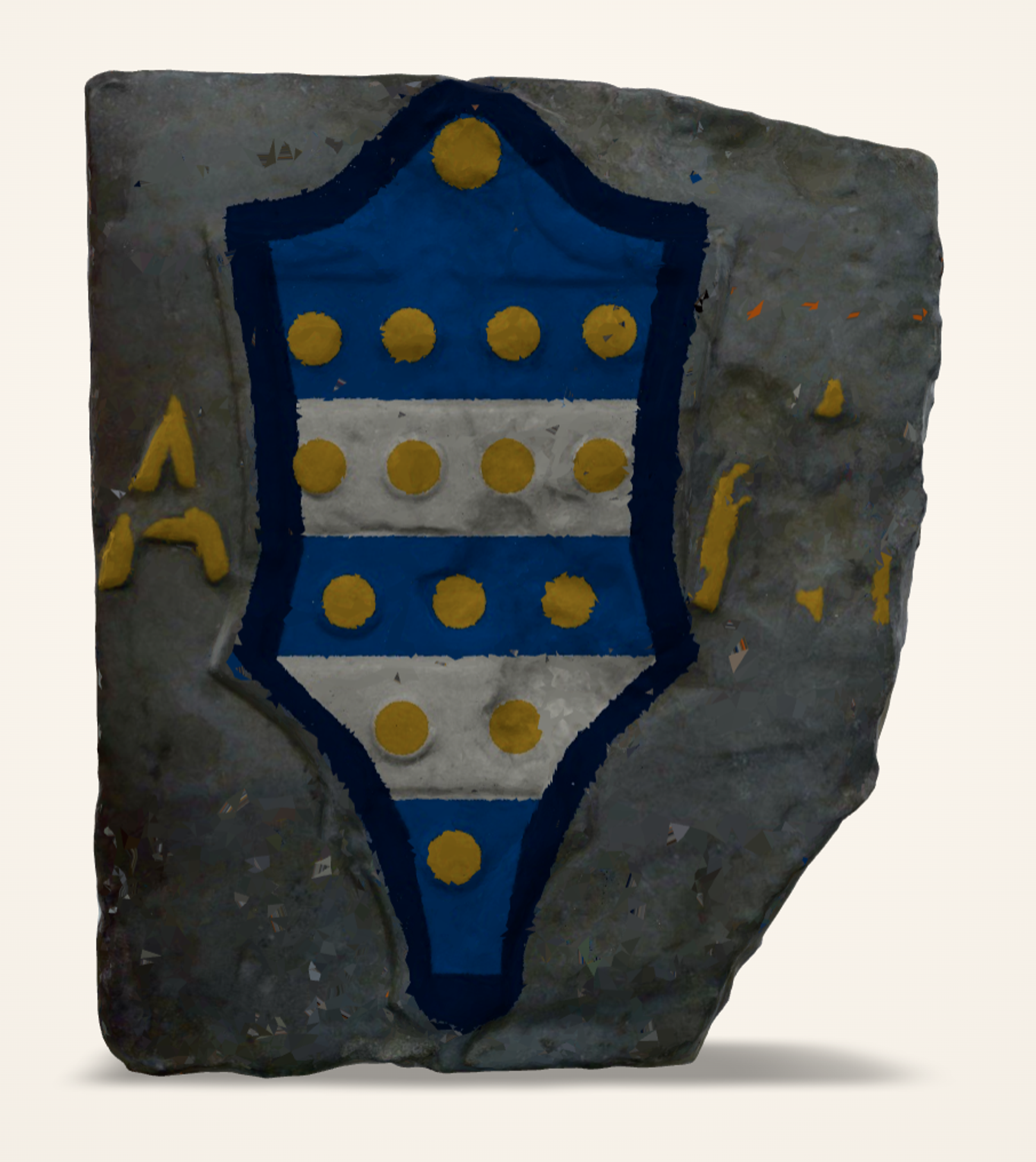
Michieli family coat of arms in stone
Kameni grb porodice Michieli
Drag to rotate · pinch to zoom
loads {mb} MBDescription
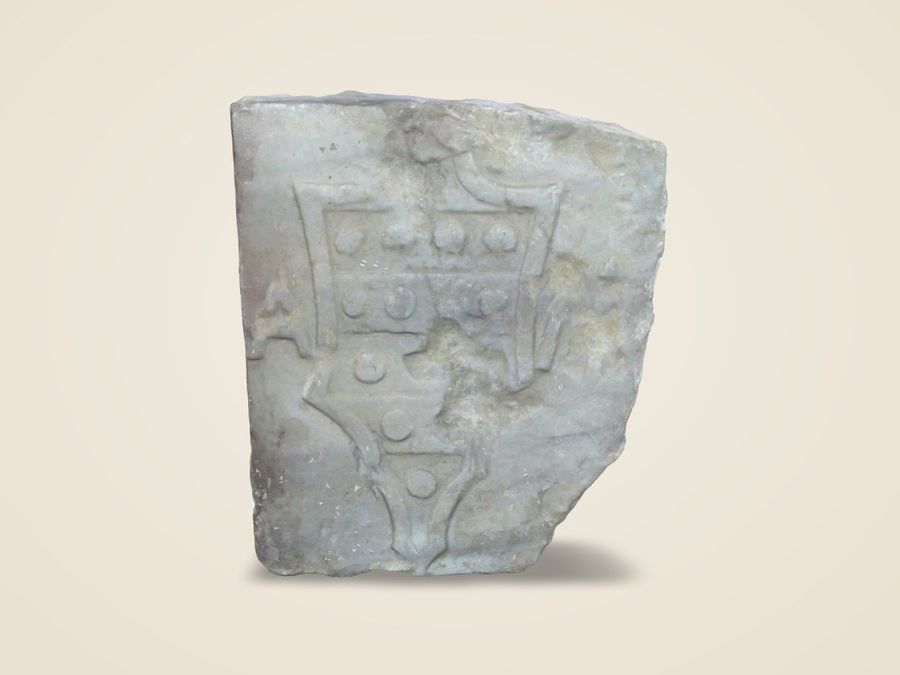
A stone slab carved in relief with the coat of arms of the **Venetian patrician house of Michieli**. To the left of the shield is the letter A, to the right the letter M: **the initials A M**. The A is well preserved; the M is damaged but clearly legible, and the museum's own label for the object records the initials AM. [1] The right part of the slab is broken off.
## 3D scan
The object was recorded by contact-free 3D scanning. The source model has **400,000 triangles**, with an average triangle edge of about **1.37 mm**: the finest measure of shape the model retains. The surface colour was captured in an 8,192 × 8,192 pixel texture, about 8.4 pixels per millimetre of surface. The mesh is closed, so both its surface area, 3,235 cm², and its volume, 9,463.2 cm³, were measured. For the web the model was reduced to 150,000 triangles and a 2,048-pixel texture; the source scan is kept for documentation, technical drawings and printing replicas.
## What is carved
The shield is of Venetian shape with a raised border, its field divided by horizontal bars. On the bars sit raised round discs, thinning out towards the point. The arrangement was not estimated from a photograph but measured on the 3D scan: five rows in the field, 4 – 4 – 3 – 2 – 1, and a fifteenth disc, larger than the rest, in the domed capital at the top of the shield, which the border passes over; there is no horizontal border beneath it. **Fifteen discs in all**, in the sequence 1 – 4 – 4 – 3 – 2 – 1. [2]
## The blazon: azure, argent and or
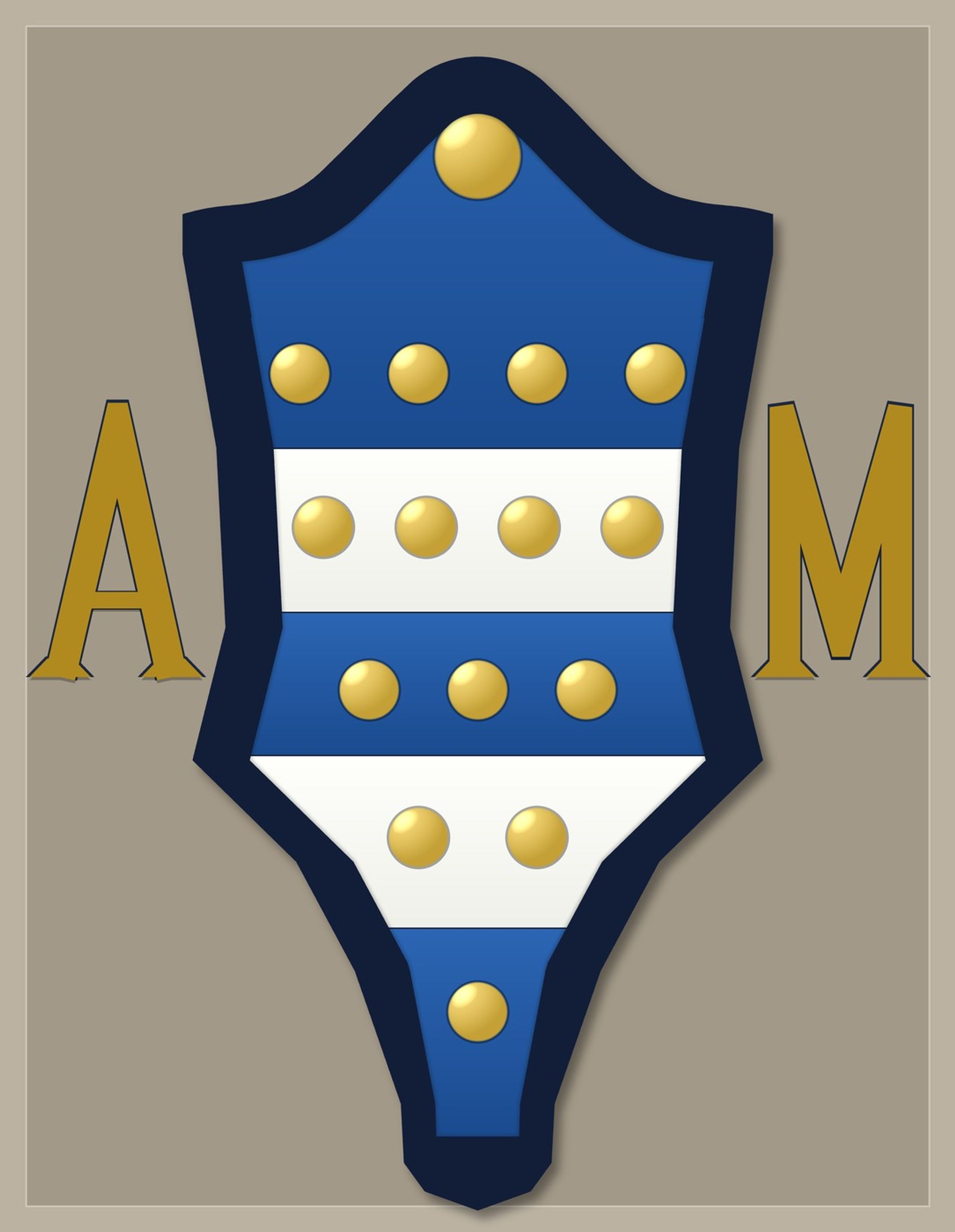
Exactly this sequence is recorded in the armorial of the Venetian patriciate under the name Michieli: “fasciato d'azzurro e d'argento, caricato da quindici bisanti d'oro, posti 1, 4, 4, 3, 2, 1” — barry azure and argent, fifteen bezants or, 1, 4, 4, 3, 2, 1 (**Stemmi delle famiglie patrizie di Venezia, no. 458**). [3] It is not a commonplace of heraldry. In a systematic search of the Italian armorial, through 600 blazons combining bars and roundels, the sequence 1, 4, 4, 3, 2, 1 **occurs once, under Michieli**, and “fifteen bezants” twice, both times under Michieli. [4]
**The stone keeps no colour; the blazon supplies it.** The “In heraldic colours” version of the 3D model is painted from it: bars blue and silver, discs and initials gold. This is how the arms look painted by the rules of heraldry. Whether the slab itself was ever painted cannot be seen on the stone.
## Money on the shield
In heraldry a bezant is not an abstract circle. Its name comes from the gold coin struck in Byzantium, and on a shield it stands for wealth, sometimes for the office of treasurer. [5] The same armorial records a Michiel shield of bars without a single disc (no. 456), beside shields with fifteen and with twenty-one (nos. 458 and 459). The house used nine variants of the shield (nos. 456–464), and its branches differed precisely in the number of discs. The Ulcinj stone bears the variant with fifteen.
## The Michiel on this coast
The Venetian registers of elections, the Segretario alle Voci, record members of the house as governors of towns on this coast seven times in seventy-two years: Domenico, count and captain of Shkodër in 1440; Marino, podestà of Bar in 1454 and 1455; Michele, count of Kotor in 1473, who died in office in 1474; **Andrea, count and captain of Ulcinj in 1479**; Francesco, castellan and chamberlain of Bar in 1502; Federico, chamberlain and captain of the Kotor citadel in 1512. [6] Only one of them is recorded in Ulcinj: Andrea.
## Andrea Michiel and the year 1479
Andrea Michiel, son of the late Giorgio, was elected count and captain of Ulcinj, Conte e Capitano di Dulcigno, in 1479. The election is entered in two books, in July and in October of that year; his successor Pietro Tiepolo was elected in 1481, matching the usual two-year term. [7] The title joined civil and military power: the court, administration and revenues of the town, and command of the fortress, the garrison and the town militia. In the sixteenth century the counts and captains of Ulcinj reported directly to the Council of Ten in Venice. [8]
The same registers show how hard the Ulcinj post was: between 1500 and 1520 elected patricians turned down the Ulcinj command nine times, three in a row in 1500. Beside their names the clerk writes one word, **“refutavit”**, he declined. That word does not stand beside the name of Andrea Michiel. [9]
## A name in stone
The Venetian governors left their names in Ulcinj. On the inner wall of the citadel the name of Giovanni Bollani, count and captain in 1450, is laid in red brick, and Pavle Mijović records further inscriptions of the rectors the Republic sent to the town, as a rule for two years. [10] Under their rule the town was also rebuilt: the cathedral church of St Mary in the upper town was restored in 1510 through the Venetian captain Alvise Delfin. [11] The slab with the Michieli arms and the initials A M belongs to the same custom, in heraldic form.
The arms of the house of Michieli and the initials A M on the same slab match one single name in the list of Venetian governors of Ulcinj: Andrea Michiel. The slab is therefore attributed to him and to his term, **1479–1481**. Where it originally stood is not known. [12] Ulcinj remained Venetian until 1571; the stone has outlived both the man who set it up and the state that sent him.
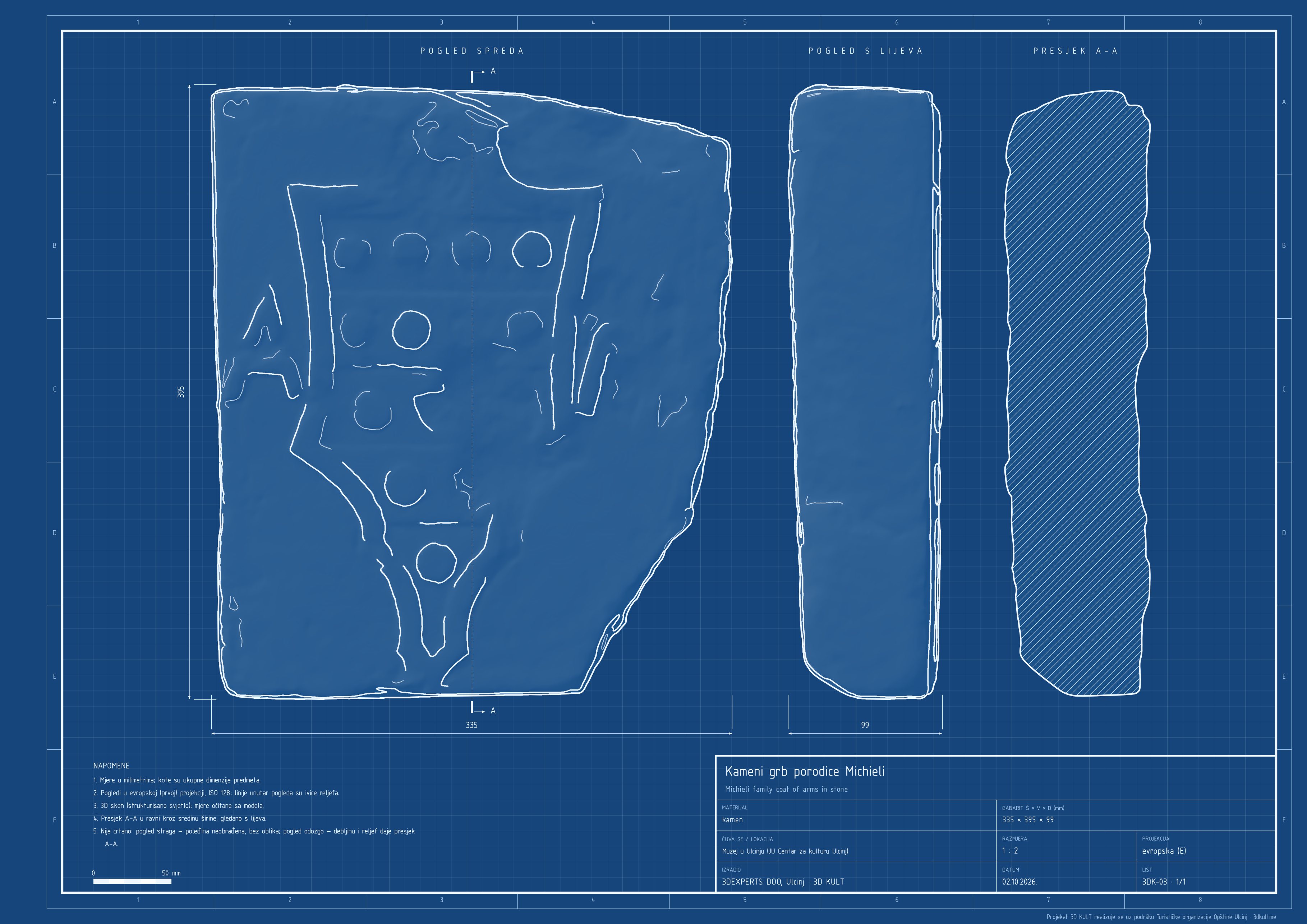
Technical drawing
 Open PDF (A3) ↓
Plates from the documentation
Literature and sources
- AA. VV., Stemmi delle famiglie patrizie di Venezia, Milano: Orsini de Marzo 2000, poz. 456–464 — navedeno prema Armoriale delle famiglie italiane (armoriale.it), odrednica „Michieli (VEN)“.
- Državni arhiv u Veneciji (ASVe), Segretario alle Voci, reg. 4, 5, 6 i 8 — preko baze The Rulers of Venice, 1332–1524, https://rulersofvenice.org: Andrea Michiel qu. Giorgio, Conte e Capitano di Dulcigno, 1479 (reg. 5 f. 29r; reg. 6 f. 76v).
- Pavle Mijović, Ulcinj, Museum Olcinium, Ulcinj 1977.
- Lovorka Čoralić, „Pisma i poruke rektora Budve, Bara i Ulcinja kao izvor za proučavanje diplomatsko-političkih zbivanja na jugu crnogorskog primorja u XVI stoljeću“, Istorijski zapisi 82, 1–2/2009, 81–96.
- CANU, Leksikon arheologije Crne Gore, odrednica „Ulcinj“ (M. Vrzić, A. Ljuljđuraj) — https://leks.canu.ac.me/web/arhcg.php?OID=7115
- CANU, Leksikon likovne umjetnosti Crne Gore, odrednica „Venecijanska utvrđenja u Crnoj Gori (XV–XVIII v.)“ (B. Ilijanić) — https://leks.canu.ac.me/web/llucg.php?OID=4290
From the same collection
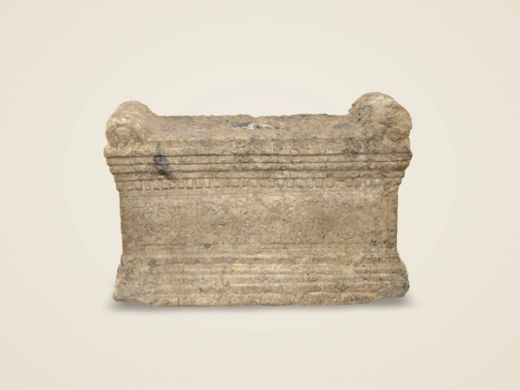
Altar of Artemis Elaphabolos
probably 1st century BC (date uncertain)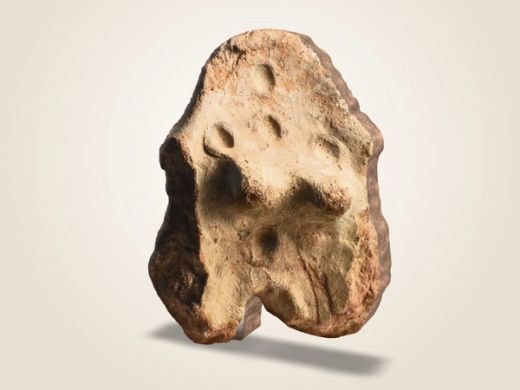
Figurine Diva Rumina of Ulcinj
Late Eneolithic / beginning of the Early Bronze Age, end of the 4th millennium BC, around 3000 BC; about 5,000 years old (approximate; the find layer is not reliable)