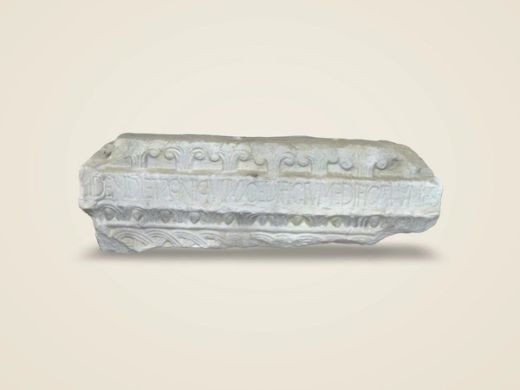
Altar of Artemis Elaphabolos
Oltar Artemide Elafabolos
Drag to rotate · pinch to zoom
loads {mb} MBDescription
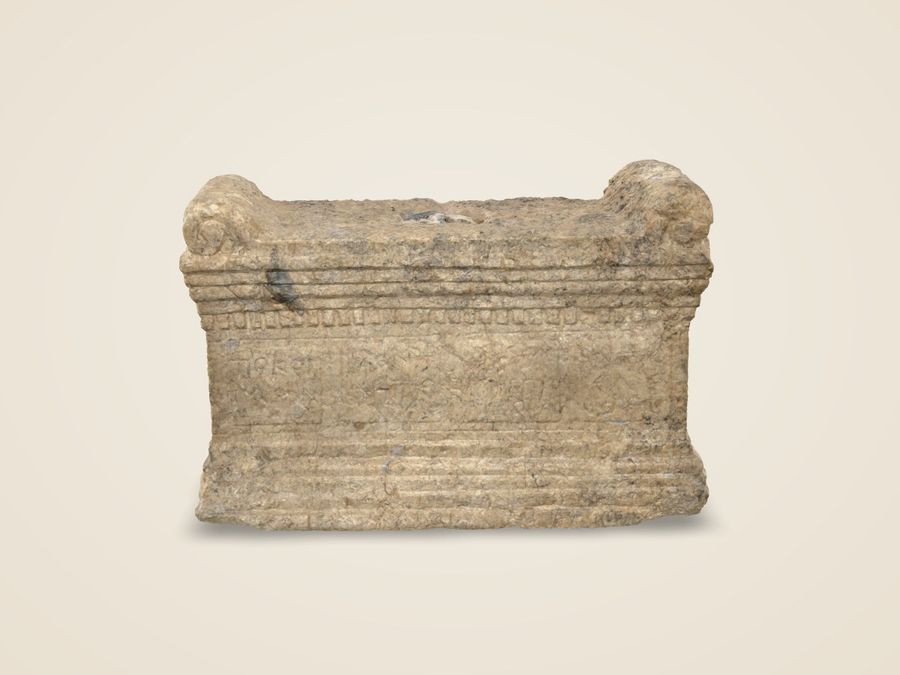
A small limestone votive altar with a Greek inscription, found in Ulcinj (ancient Olcinium) and kept in the Museum of Ulcinj. It was dedicated by an **association of stonecutters** to **Artemis Elaphabolos**, “the Deer Slayer”. On the crown is a **rectangular socket filled with lead**, in which an object, now lost, was once fixed. The Lexicon of the Archaeology of Montenegro describes it as a recess for a separate stele; the 3D scan measured it and revealed **the channel through which the lead was poured**. Whether a stele, a small bronze statuette or something else stood here has not been established. [1]
## 3D scan
The object was recorded by contact-free 3D scanning. The source model has **10 million triangles**, with an average triangle edge of about **0.23 mm**: the finest measure of shape the model retains. The surface colour was captured in an 8,192 × 8,192 pixel texture, about 12.4 pixels per millimetre of surface. The mesh is closed, so both its surface area, 2,261.7 cm², and its volume, 5,280.7 cm³, were measured. For the web the model was reduced to 150,000 triangles and a 2,048-pixel texture; the source scan is kept for documentation, technical drawings and printing replicas.
## Stone and form
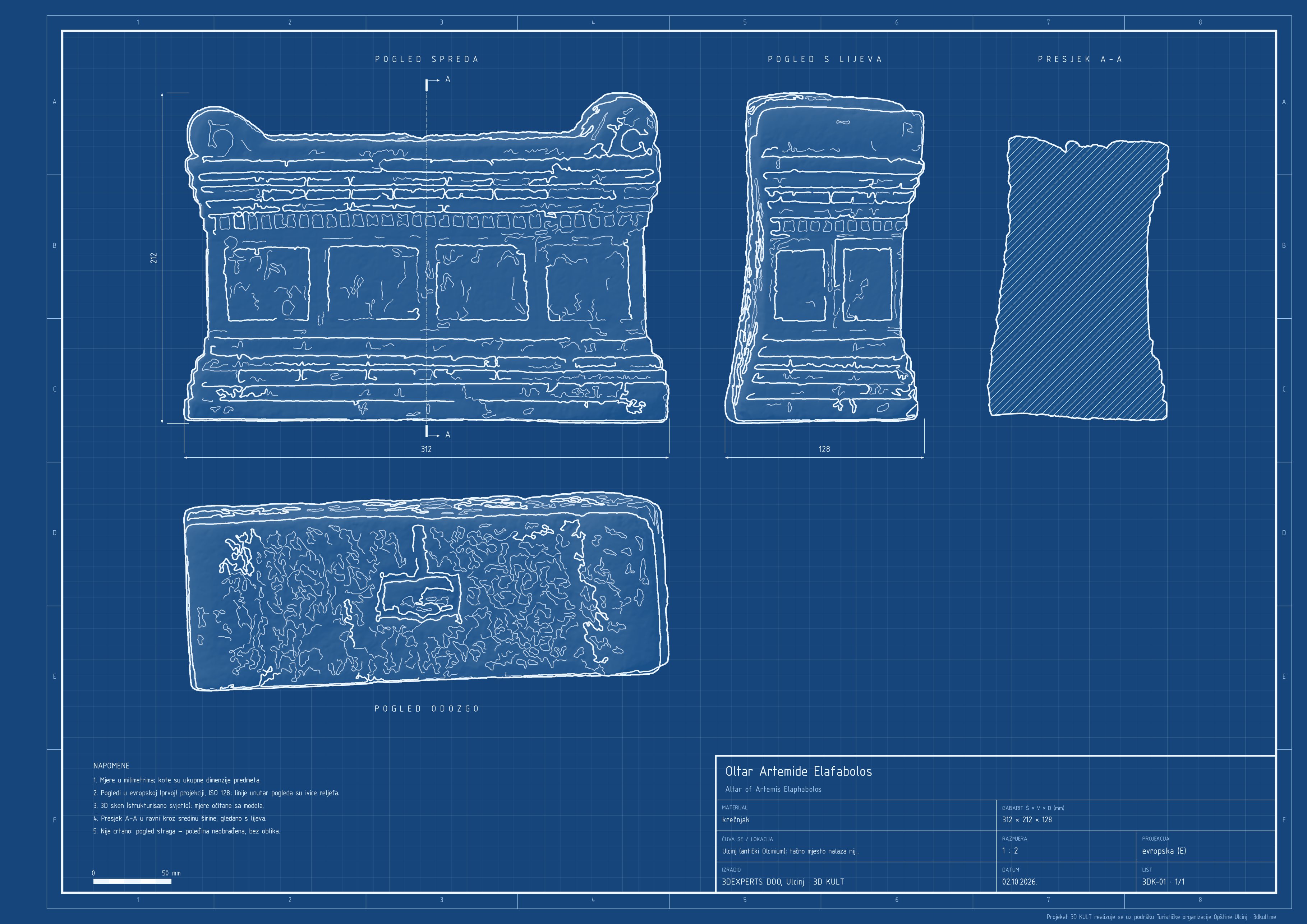
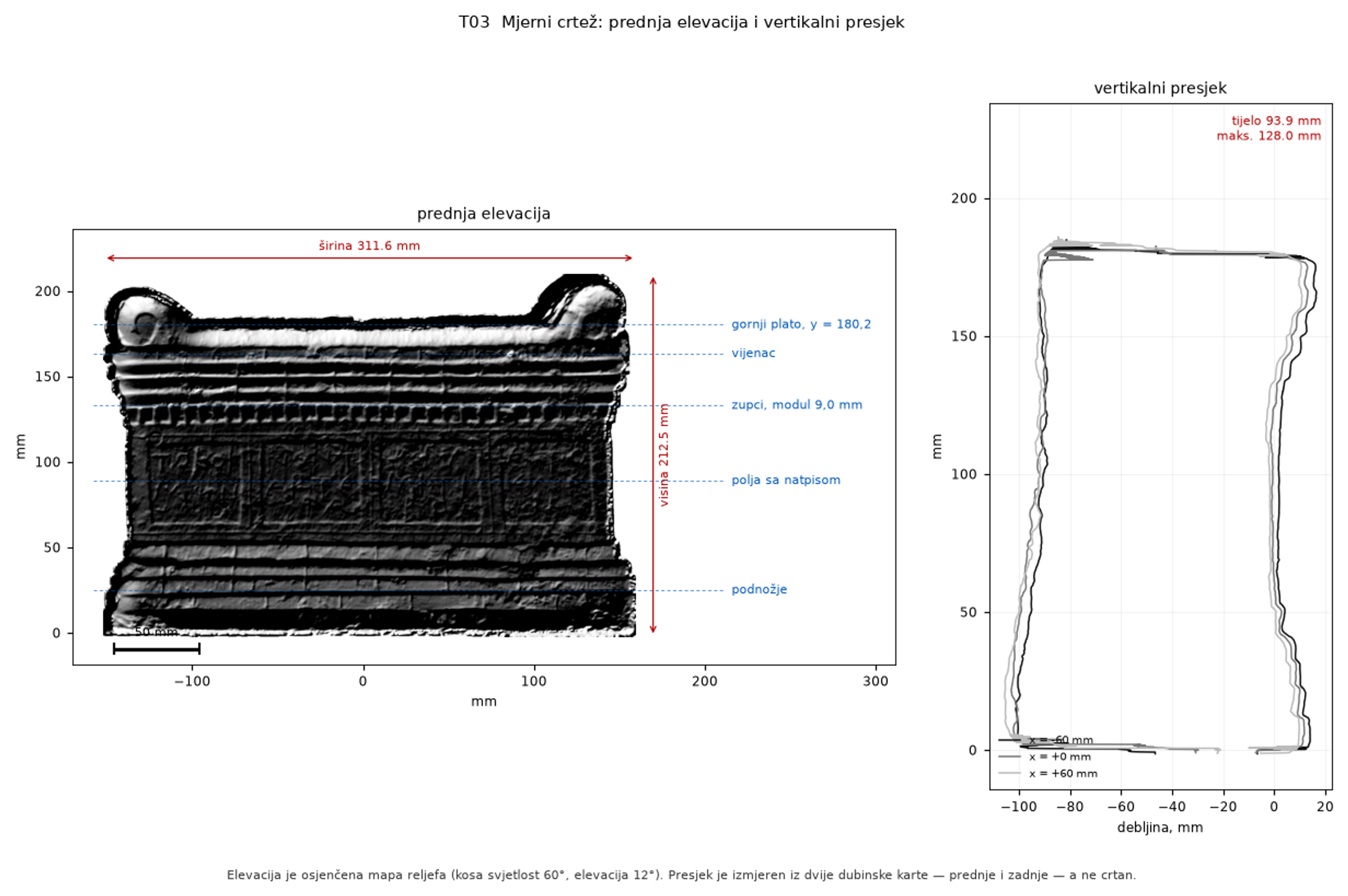
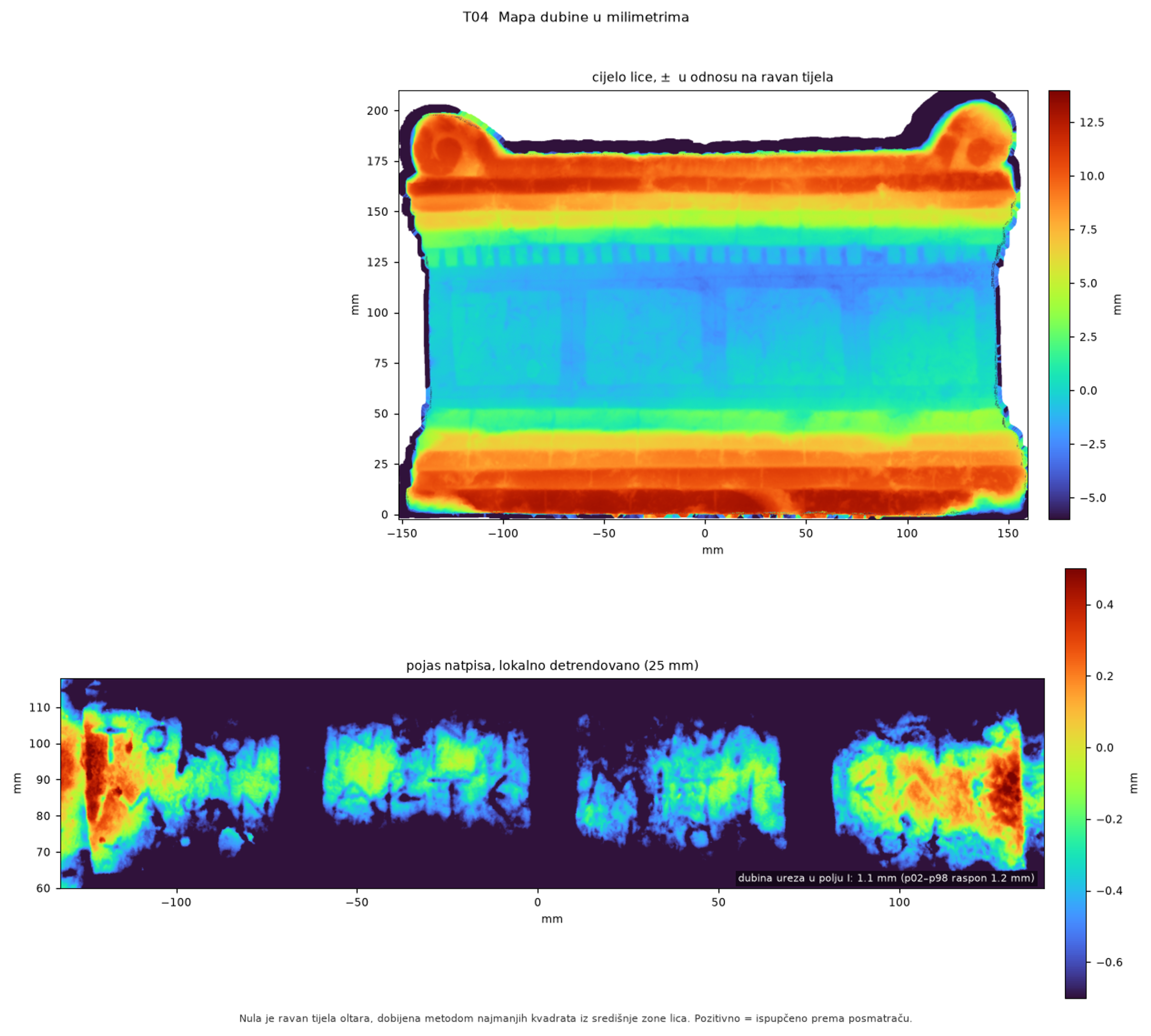
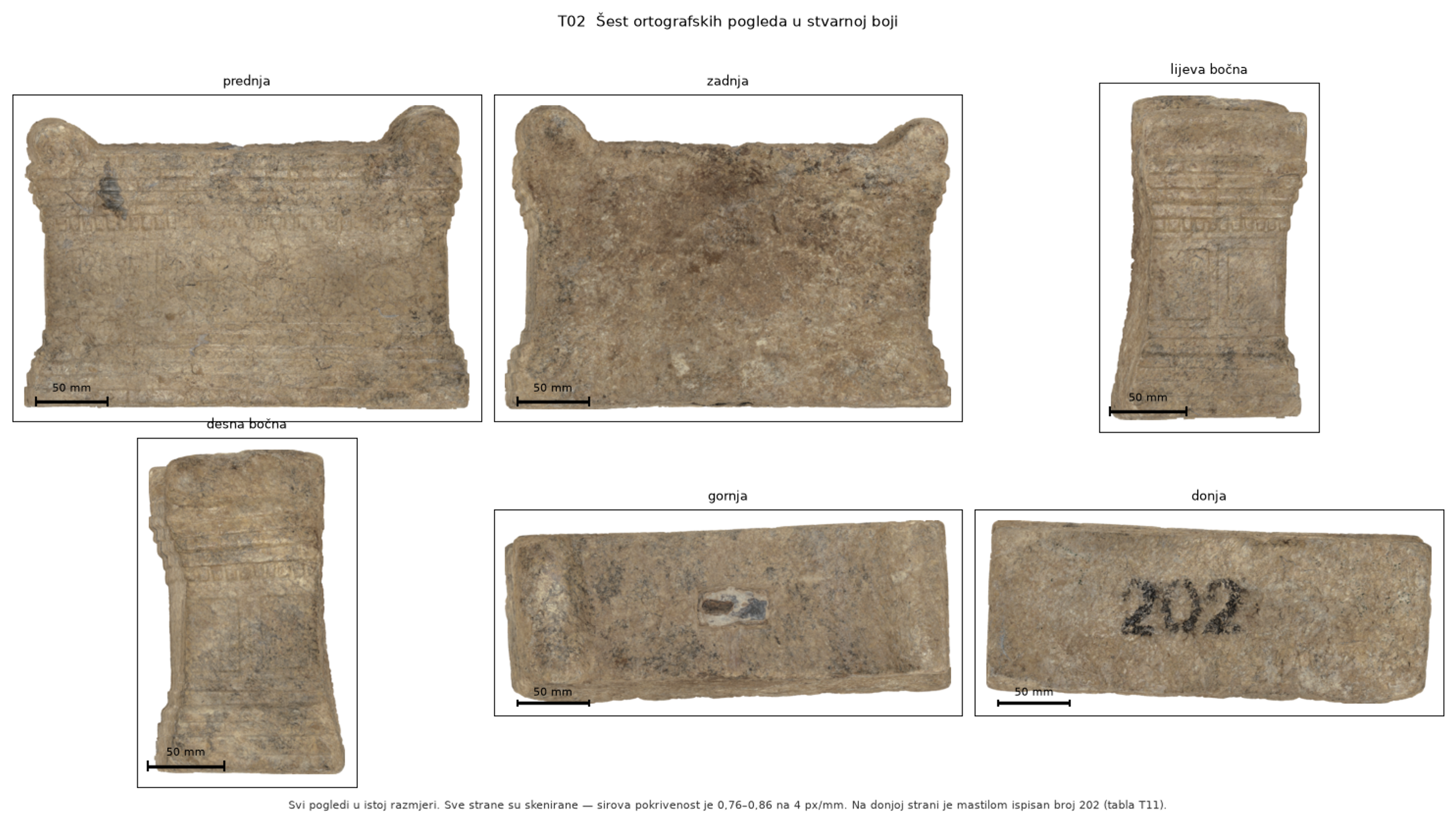
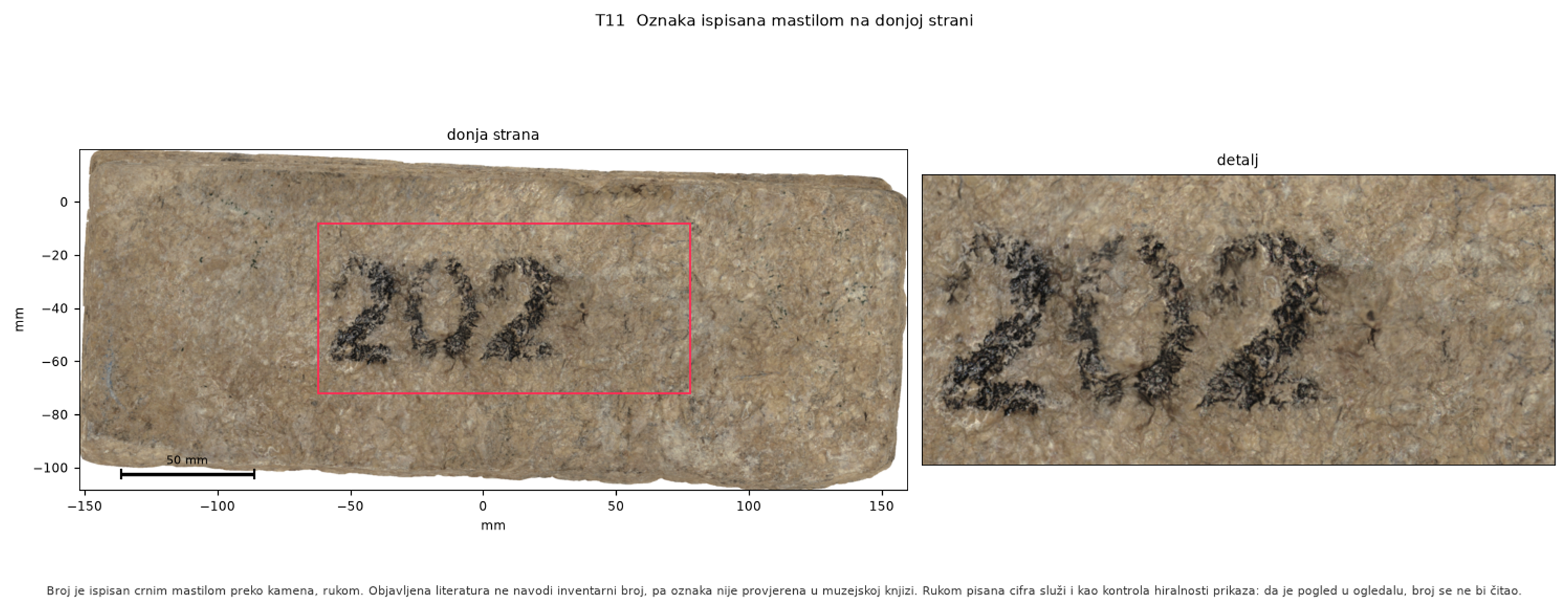
The altar is low and wide: on the 3D scan it is **311.6 mm** wide, **212.5 mm** high and at most **128.0 mm** deep. Vujčić and Pelcer-Vujačić give its dimensions as 31 × 21 × 9.5 cm, and the scan confirms them: 9.5 cm is the thickness of the body itself, which on the scan ranges from 90 to 96 mm, since the stone was carved by hand. Only the cornice and base that frame it are deeper. From the volume of the model, 5,280 cm³, the weight of the altar is estimated at **about 13–14 kg**. [2] The crown carries two cylindrical pulvini, with a cornice and a row of dentils below them. The number 202 is written in black ink on the underside. [3]
## The inscription
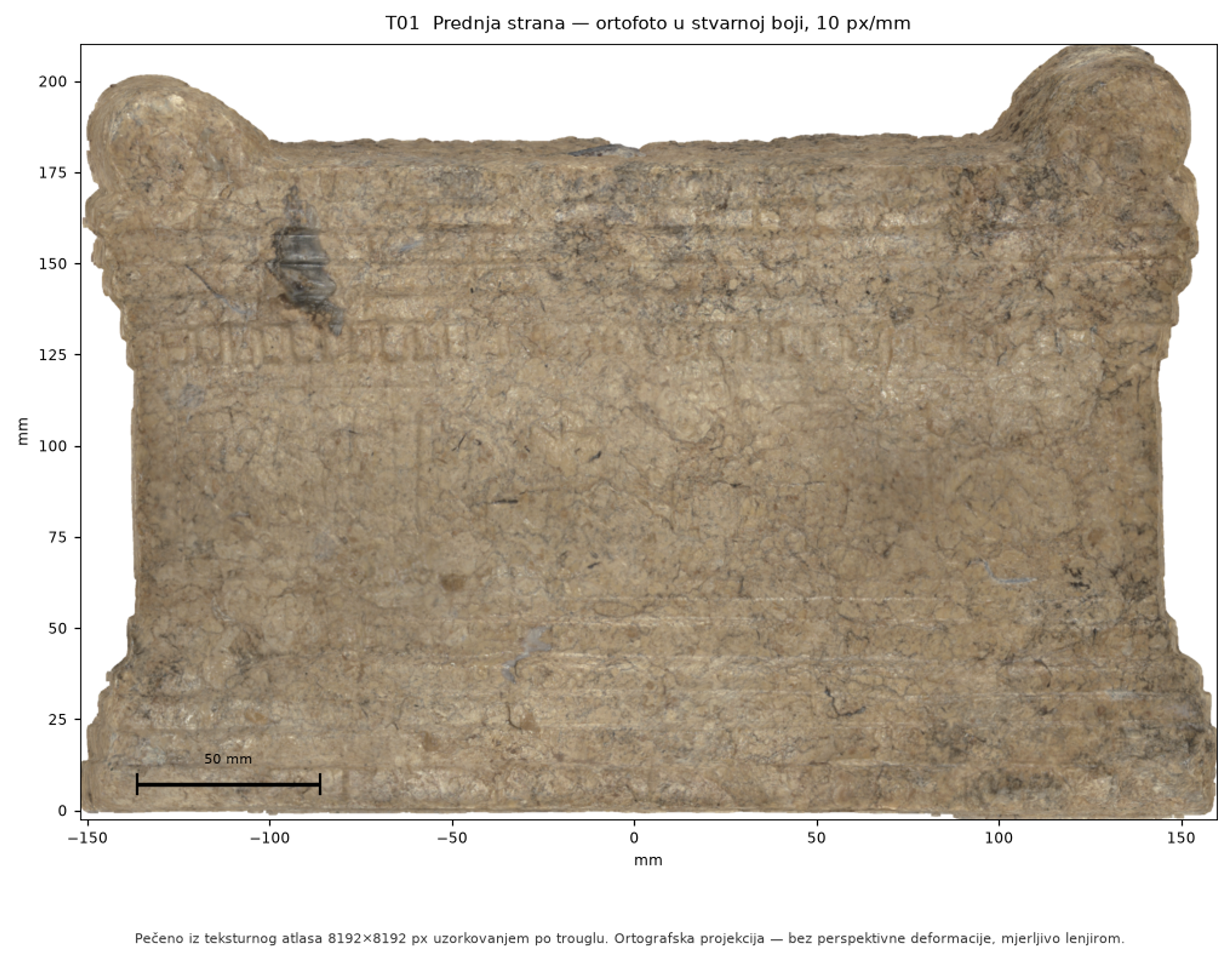
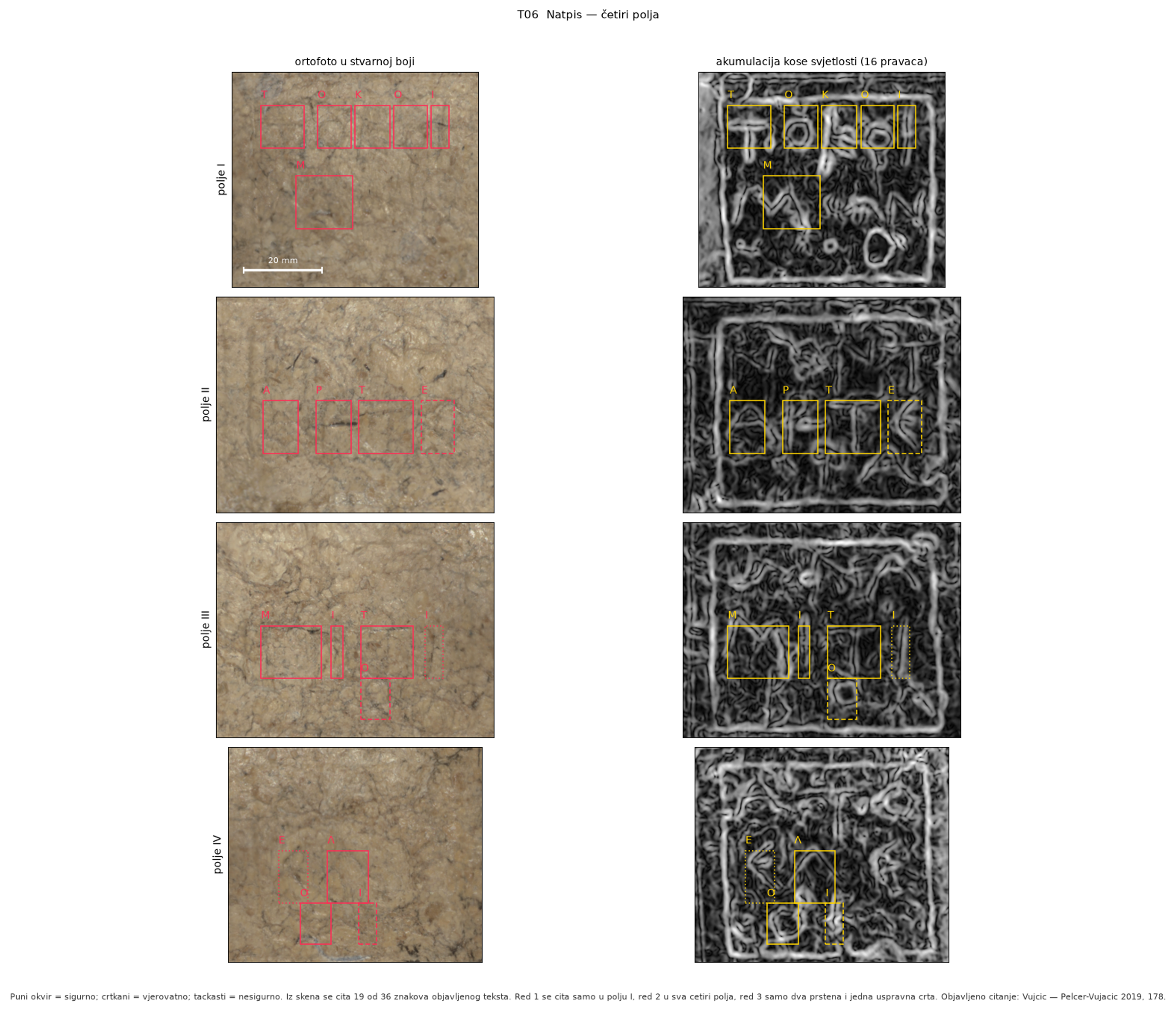
On the front, inside four square panels, three lines of Greek are shallowly cut. The letters are of uneven size; those of the third line are cramped into the space left in the second, third and fourth panels. In the edition of Vujčić and Pelcer-Vujačić (2019) the inscription reads:
τὸ κοινὸν τõν λατό- / μον Ἀρτέμιτι Ἐλα- / φαβόλοι
“The association of stonecutters to Artemis Elaphabolos.” **The text is complete.** Omicron is cut throughout where classical Greek would write omega, reflecting the shortening of long vowels in late Hellenistic and Imperial pronunciation. The dative Ἀρτέμιτι is a late Doric, or Northwest Greek, form; earlier editors took it for a mason’s error. [4] On the scan the letters are only about a quarter of a millimetre deep. [5]
## Who the λατόμοι were
A λατόμος is a quarry worker, the man who cuts and roughly dresses stone. The dedicant is not an individual but their association, a κοινόν; **the inscription names no one**. Such associations appear in the sources very rarely. Quarries were often worked by slaves, convicts and forced labourers, and free quarrymen were among the poorest, so it is unusual for their association to appear in stone at all. Professional associations emerge only gradually in the Hellenistic age and multiply sharply in the 1st century AD. The few secure attestations of stonecutters’ associations cited by Vujčić and Pelcer-Vujačić all belong to the Roman Imperial period, from the mid-1st to the 4th century AD. [6] If the Ulcinj altar dates from the 1st century BC, **it is the oldest known dedication by such an association**.
## Artemis the Deer Slayer
Ἐλαφαβόλος is the Doric form of ἐλαφηβόλος, “she who shoots (brings down) deer”. The Homeric Hymn to Artemis uses the same word for the goddess: “ἐλαφηβόλον ἰοχέαιραν”, the deer-slayer who showers arrows. [7] This is Artemis the huntress, with bow and quiver. The cult of Artemis Elaphabolos was widespread in the Greek world, so it does not in itself reveal where the dedicants came from. [8] Why an association of stonecutters made its vow to her in particular, the inscription does not say.
## Where the altar comes from
The exact find-spot was not recorded. The first editors, Mijović and Kovačević (1975), believed the altar was made in Ulcinj but set up by stonemasons from elsewhere, probably from Delphi; they gave no reasons. [9] Vujčić and Pelcer-Vujačić consider it unlikely that the inscription was cut near its find-spot. In their view the altar comes from the wider Adriatic and Ionian area, and the Doric forms do not narrow it down, since Doric-speaking settlements were numerous on the shores of both seas. [10]
## When it was made
The date is uncertain. Mijović and Kovačević placed the altar in the 5th–3rd century BC, assuming it was contemporary with the walls of Ulcinj. Martinović (2011) called it very early, archaic, and then dated it to the late 5th or early 4th century BC. Vujčić and Pelcer-Vujačić reject both estimates. In their analysis the letter forms (omicron smaller than the other letters, an almost lunate epsilon, alpha with a single horizontal cross-bar, M with straight, splayed strokes) point to the early or middle Hellenistic period, though not securely; the dialect also allows the 2nd century BC; and the mention of a stonecutters’ association pulls strongly towards the late Hellenistic or early Roman period. They conclude that the inscription was probably cut in the 1st century BC, without excluding the 2nd, and leave open the possibility that it was cut later than the altar itself. [11]
## The socket on the crown
On the crown, between the pulvini, the 3D scan shows a rectangular socket of 55.3 × 31.6 mm, set slightly to the left of centre as seen from the inscription. A narrow channel runs from the socket to the back, its floor sloping down towards the socket: **the lead was poured from the back of the altar and ran into the socket**. [12] In the socket lie two masses, 22.6 × 11.2 mm and 25.1 × 15.4 mm, their centres 21.9 mm apart, both elongated front to back. In colour they differ from the limestone of the altar and from each other; what they are made of has not been established. [13] Around them remains a groove, on average about 4 mm deep and up to 14 mm at its deepest.
The technique is known from antiquity: a metal tang, cast together with the object, is set into a hole cut in the stone and fixed with molten lead. An Attic inscription of the 4th century BC orders that on top of a monument “the tripod be fitted, holes drilled for its feet and lead poured around them”, and at Aquileia a stone base of a bronze statue survives with two feet fixed in lead. [14]
## What may have stood on the altar
**The object itself is lost.** Most probably it was a small bronze statuette of the goddess: the socket is elongated, as a standing figure requires, and two masses 21.9 mm apart match two tangs under the feet of a figure standing with its feet side by side, facing whoever reads the inscription. [15] The size of the socket and the proportions of surviving bronze statuettes give **a figure about 13–15 cm tall**. [16]
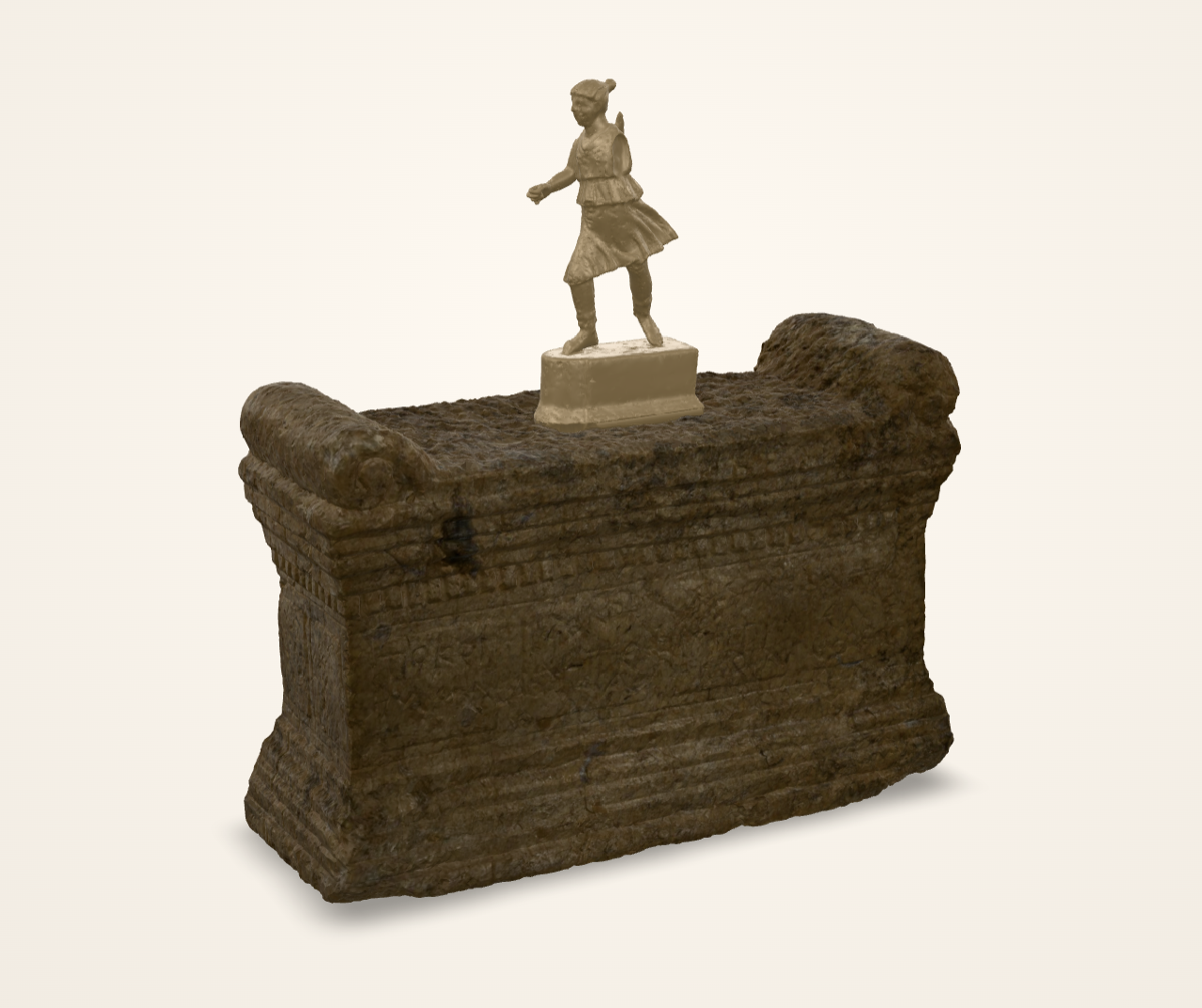
What it looked like is suggested by the inscription itself. Elaphabolos is Artemis with the bow: in a short chiton, bow in hand and quiver on her shoulder, reaching for an arrow or drawing the string. The type is known from bronze statuettes of the Hellenistic and Roman periods, from the late 4th century BC to the 3rd century AD. The closest example in date is a statuette in the Metropolitan Museum of Art, New York (acc. 1980.303.3), Hellenistic, 3rd–1st century BC, 19.7 cm high: Artemis draws an arrow from her quiver. Its find-spot is unknown, so it illustrates the type, not this coast. [17] The closest example in place is the bronze Artemis from Blatnica near Mostar, 3rd–4th century AD, in the National Museum of Bosnia and Herzegovina in Sarajevo. She strides, one foot in front of the other, and stands on her own base, so she would not fit this socket; she does show what a small bronze Artemis looked like on the eastern Adriatic shore. [18]
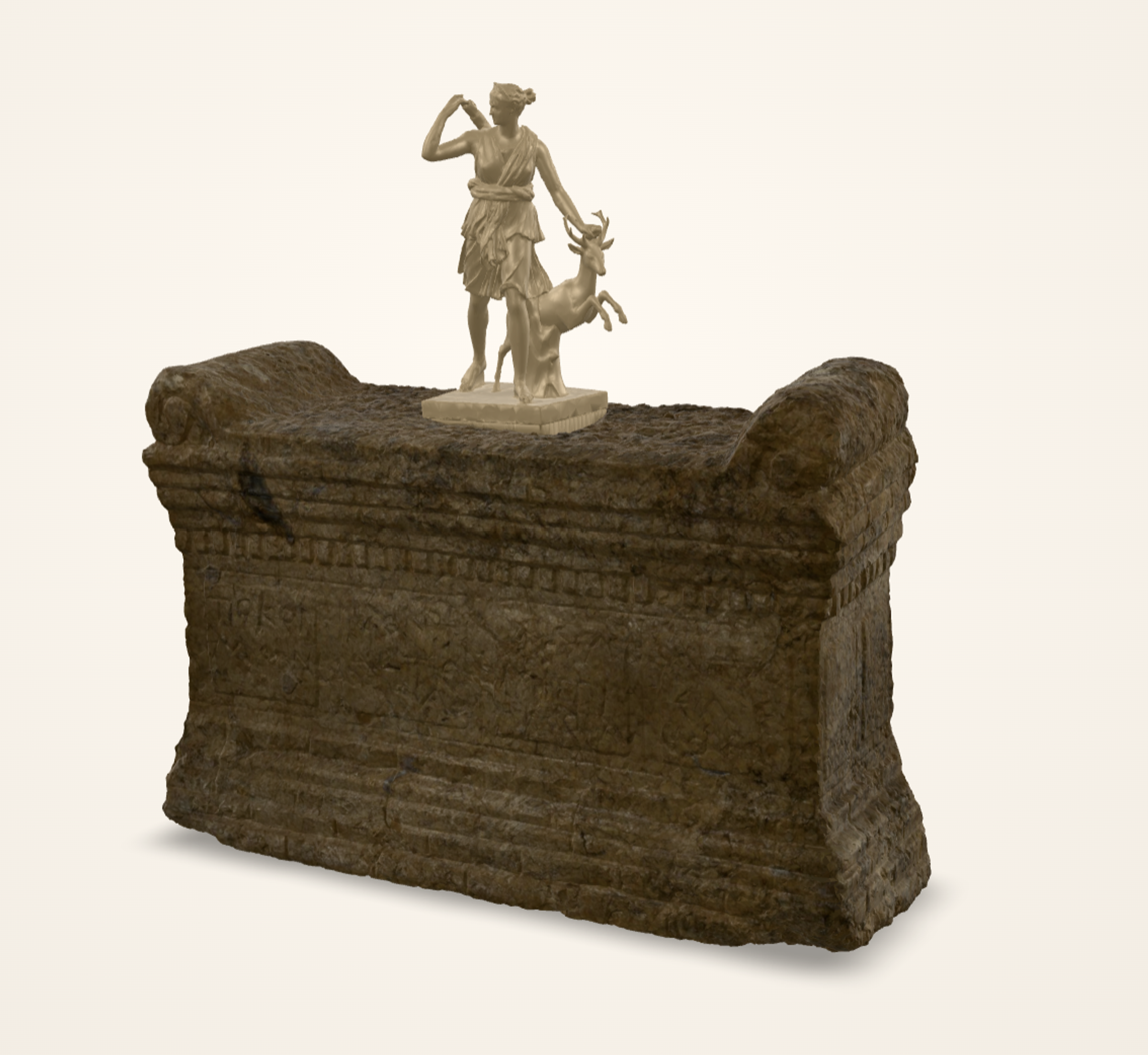
Two common images of Artemis are ruled out here. A figure with a deer at her side, like the Diana of Versailles, needs a broad plinth that does not fit a 55 × 32 mm socket. [19] Artemis with a torch, as on the coins of Rhizon and of King Ballaios from this coast, is the local image of the goddess, but with a different attribute: the torch belongs to Artemis the light-bringer, not to the Deer Slayer. [20]
Nor can it be ruled out that no figure stood on the altar at all. The Lexicon of the Archaeology of Montenegro interprets the socket as a recess **for a separate stele**, an upright stone slab set into the altar. [21] The only ancient text describing lead poured on top of a monument speaks of a tripod. [22]
## What would settle the question
Three simple examinations could decide between these possibilities: a magnet on the masses in the socket (if it attracts them, they are iron; if not, and the masses are heavy and grey, lead); XRF analysis, which shows the composition without taking a sample; and an examination of the socket at 10–20× magnification, where three separate contact marks would mean a tripod and two marks side by side the feet of a figure. **None of these has yet been carried out.**
Technical drawing
 Open PDF (A3) ↓
Plates from the documentation
Literature and sources
- N. Vujčić, O. Pelcer-Vujačić, „Some notes on two Greek inscriptions from Montenegro“, Arheološki vestnik 70 (2019), 173–183 (oltar iz Ulcinja: 177–180). CC BY-NC-SA 4.0 — http://av.zrc-sazu.si/pdf/70/AV_70_07_Vujcic_Pelcer-Vujacic.pdf
- P. Mijović, M. Kovačević, Gradovi i utvrđenja u Crnoj Gori, Beograd – Ulcinj 1975, 32 (prva objava).
- J. J. Martinović, Antički natpisi u Crnoj Gori. Corpus inscriptionum Latinarum et Graecarum Montenegri, Kotor 2011, 284–285.
- Ph. Harland, „Dedication to Artemis Elaphabolos by an Association of Stonecutters“, Associations in the Greco-Roman World (mrežno izdanje, 2016); PHI 310744, AGRW 22073.
- IG II² 1665 — PHI Greek Inscriptions, br. 3890: https://epigraphy.packhum.org/text/3890
- P. Ventura, „Sulle tracce della scultura aquileiese: base di statua bronzea con ancoraggio in piombo di due piedi maschili calzati“, u: B. Callegher (ur.), Studia archaeologica Monika Verzár Bass dicata, Trieste 2015, 155–163; lupa.at 14602 — https://lupa.at/14602
- D. Bourgarit, J. Bassett, F. G. Bewer, A. Heginbotham, A. Lacey, P. Motture (ur.), Guidelines for the Technical Examination of Bronze Sculpture, Los Angeles: Getty Conservation Institute — https://www.getty.edu/publications/bronze-guidelines/
- The Metropolitan Museum of Art, „Bronze statuette of Artemis“, inv. 1980.303.3 — https://www.metmuseum.org/art/collection/search/255695
- Global Digital Heritage, DIGI.BA, Zemaljski muzej Bosne i Hercegovine, „Bronze Artemis, Blatnica, Mostar, Bosnia“ (NMB BH114.1), CC BY-NC 4.0 — https://sketchfab.com/3d-models/bronze-artemis-blatnica-mostar-bosnia-16c0cdcd118e4fa6a1a628720208bd32
- Homerske himne, XXVII: Artemidi.
- CANU, Leksikon arheologije Crne Gore, odrednica „Artemida“ (D. Gazivoda, Č. Marković, A. Ljuljđuraj) — https://leks.canu.ac.me/web/arhcg.php?OID=6626
- CANU, Leksikon arheologije Crne Gore, odrednica „Ulcinj“ (M. Vrzić, A. Ljuljđuraj) — https://leks.canu.ac.me/web/arhcg.php?OID=7115
From the same collection
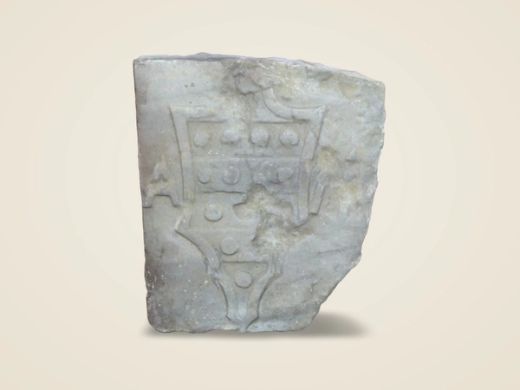
Michieli family coat of arms in stone
Venetian period, 15th century: 1479–1481 (term of Andrea Michiel)
Figurine Diva Rumina of Ulcinj
Late Eneolithic / beginning of the Early Bronze Age, end of the 4th millennium BC, around 3000 BC; about 5,000 years old (approximate; the find layer is not reliable)