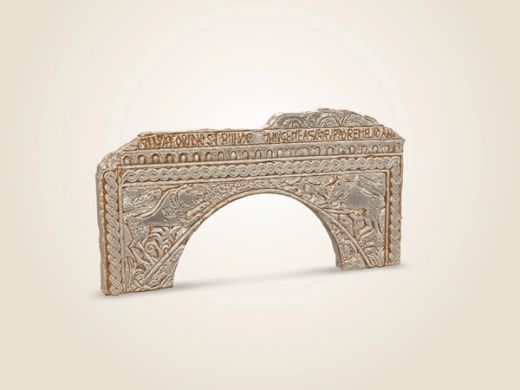
Fragment of the Ulcinj ciborium
Ulomak ulcinjskog ciborijuma
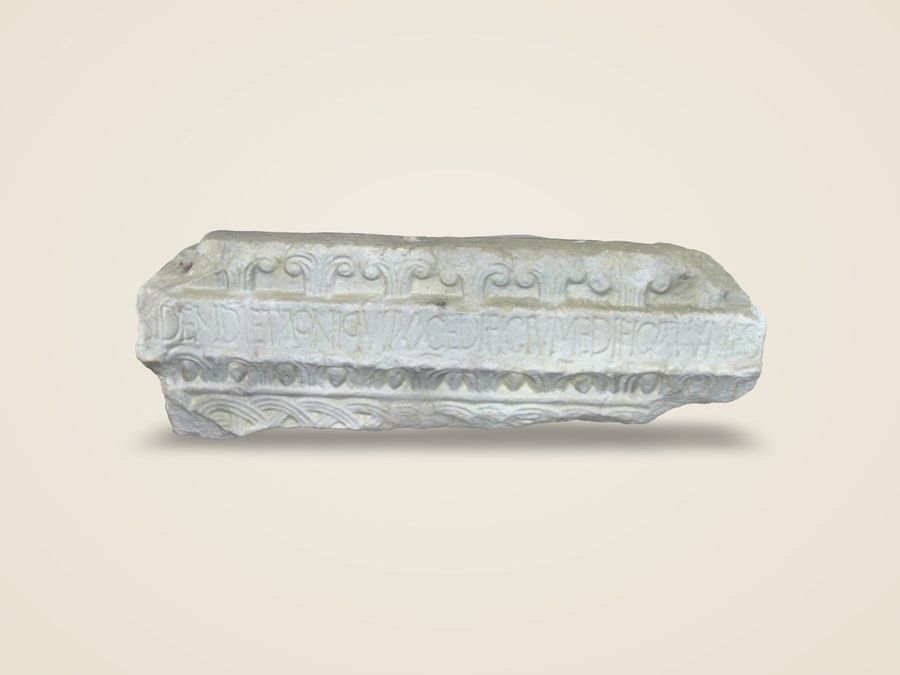
Drag to rotate · pinch to zoom
loads {mb} MBDescription
A stone fragment of the upper band of one side of a ciborium — the four-arched stone canopy that stood over the altar of **an early medieval church in the Old Town of Ulcinj**, of the 9th century. The ciborium was broken up long ago and its fragments are scattered from Ulcinj to Belgrade. This one was 3D-scanned: the scan measured the fragment, the depth of the inscription's letters and the fragment's place on its side of the ciborium. [1]
## 3D scan
The object was recorded by contact-free 3D scanning. The source model has **1.1 million triangles**, with an average triangle edge of about **0.98 mm**: the finest measure of shape the model retains. The surface colour was captured in an 8,192 × 8,192 pixel texture, about 6.1 pixels per millimetre of surface. The mesh is closed, so both its surface area, 4,656.1 cm², and its volume, 13,866.4 cm³, were measured. For the web the model was reduced to 150,000 triangles and a 2,048-pixel texture; the source scan is kept for documentation, technical drawings and printing replicas.
## Church and dedication
It is not certain which church in Ulcinj the ciborium belonged to. It is thought to come from a single-nave early medieval church above the southern town gate, on whose site a new church was built in the 13th century, later destroyed under Ottoman rule. [2] According to the reconstruction of the inscription, the ciborium was dedicated to **Christ the Saviour**. [3]
## What it looked like
The ciborium was four-sided, with a roof in the form of a four-sided pyramid. On the front, two lions face each other, the right one chasing a smaller animal; the space beneath them is filled with palms. The arch is decorated with an interlaced triple band, the panel is framed by a plait with "eyelets", and along the cornice runs a frieze of ovolos and small arches, above which the inscription is carved in rustic capitals, without spaces between words. [4] Its closest relatives are the ciboria of Kotor, Komolac and Dubrovnik. [5] The ciborium was of **marble**; it is thought to be the work of the Kotor stonemasons' workshop, made shortly after the younger ciborium of the Cathedral of St Tryphon in Kotor, that is, after 809. Its fragments were found in a 9th-century pre-Romanesque church in the lower town, and pieces were built into several buildings of the Old Town as building stone. [6]
## Guzma, the Holy Saviour and two emperors
The ciborium is a votive gift. It was erected by **a woman named Guzma**, pro remedio animae — for the salvation of her soul; her husband, whose name cannot be read on the surviving fragments, carried out her wish. The inscription also names two emperors, Leo and Constantine, and the ciborium is dated by them. The more widely accepted reading is Leo V and his son and co-emperor Constantine, which places the ciborium in **813–820**; more recent interpretations also allow Leo III and Constantine V (720–741). [7]
## The side in Belgrade
The largest fragment, a whole side with the arch and the lions, was taken around 1937 to the **National Museum in Belgrade**, where it is still kept; the other surviving fragments are in the Museum of Ulcinj. [8] That side exists in this collection as a separate model, reconstructed from photographs.
## This fragment
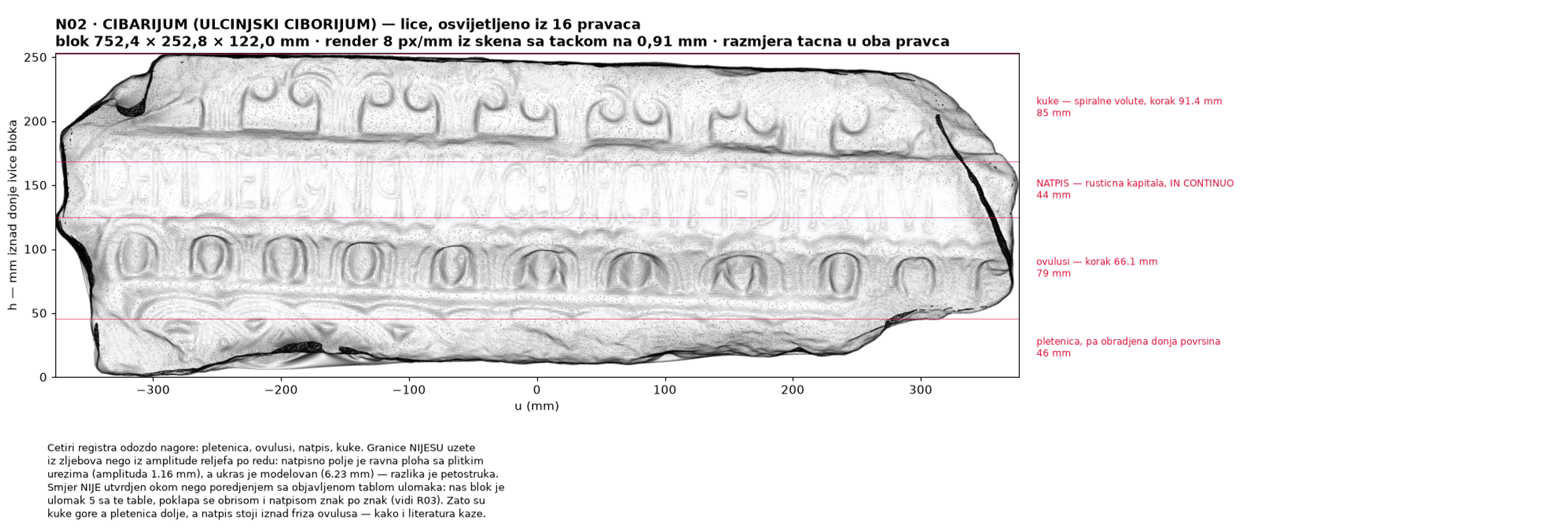
The fragment is 752 mm long, 253 mm high and 122 mm thick. On its face four bands run from top to bottom: crockets (paired spiral volutes), the inscription, a frieze of ovolos and a plait. Both ends are breaks; the underside is dressed flat, unlike the breaks; the back is only roughly dressed, since it was not meant to be seen. [9]
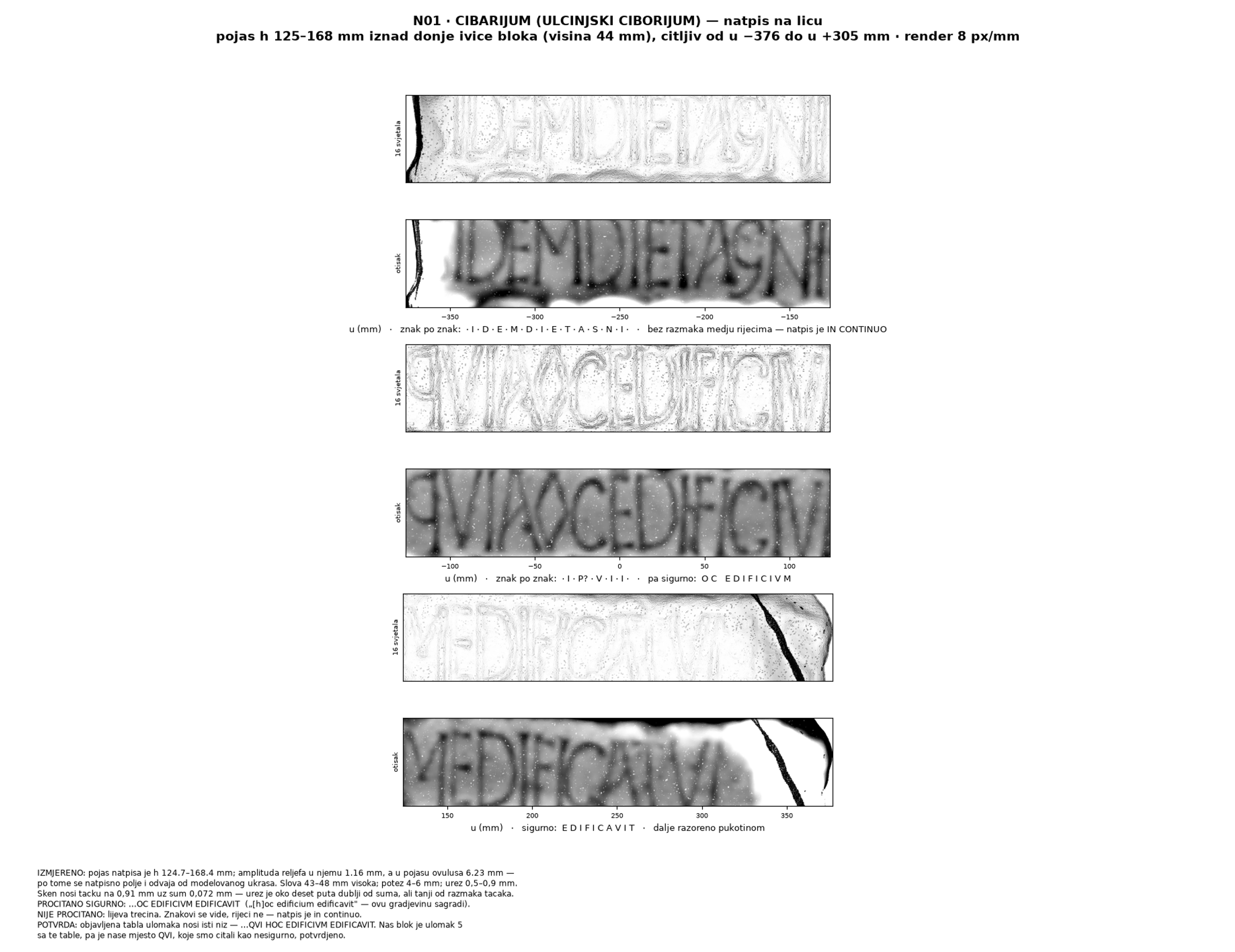
The letters of the inscription are 43–48 mm high but cut only **0.5–0.9 mm deep** — at the very limit of what the scan records. On the published photograph of the same fragment the inscription is visible to the naked eye along its whole length; on the scan, lit virtually from sixteen directions, it reads **…OC EDIFICIVM EDIFICAVIT**, "[who] built this building". [10] [11] The crockets at the top repeat every 91.4 mm; fifteen such steps give a side of 1.37 m, which agrees with the published plate of the fragments to within one per cent. On that plate the word QVI also stands before these words. [12]
## The reconstruction
The 3D KULT reconstruction is a drawing in which every surface carries a grade of evidence, not a stone pretending to be the original. Of the visible face of the four sides, **only 5.5 % is measured on this scan**, 28.3 % comes from the published drawing and 66.1 % is assumption. [13]
## What would settle the question
The museum record with the numbers of the fragments now in Ulcinj; a 3D scan of the Belgrade side, which would multiply the measured share of the reconstruction; and an epigrapher's view of the reading taken from the scan. Even then the height of the columns would remain unknown: not a single fragment of a column or capital survives.
Technical drawing
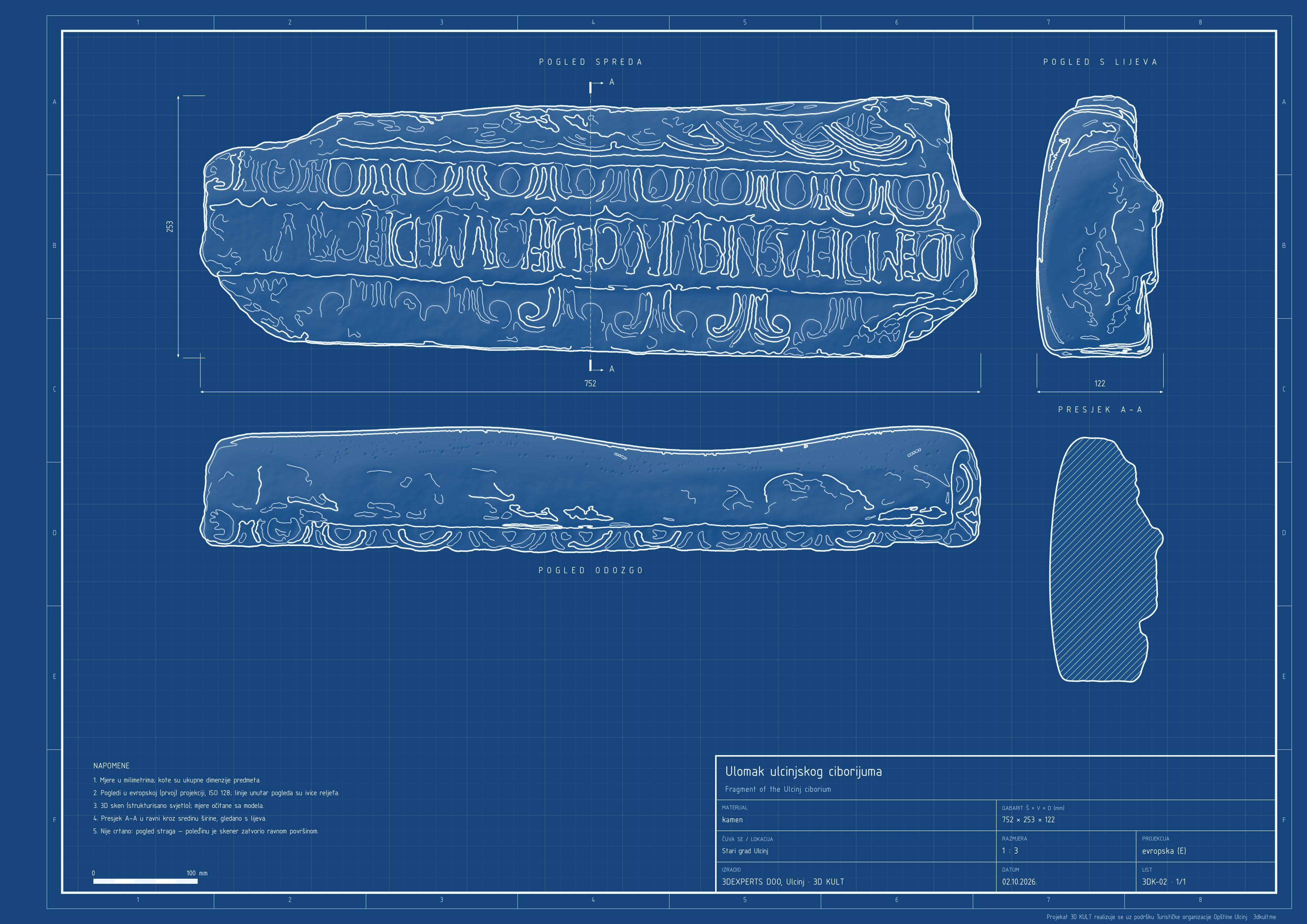 Open PDF (A3) ↓
Plates from the documentation
Literature and sources
- T. Koprivica, „Ulcinj, ciborijum“, Leksikon likovne umjetnosti Crne Gore, CANU — https://leks.canu.ac.me/web/llucg.php?OID=3982
- Narodni muzej Srbije, „Deo ciborijuma iz Ulcinja, IX vek“, objava na zvaničnoj Facebook stranici muzeja — https://www.facebook.com/narodnimuzej/posts/10157807239194646
- J. Kovačević, „Od doseljavanja Slovena do kraja XII vijeka“, Istorija Crne Gore I, Titograd 1967.
- Đ. Bošković, P. Mijović, M. Kovačević, Ulcinj I, Beograd 1981.
- P. Mijović, „Ulcinjski ciborijum“, Starinar n. s. XXXVI (1985), 91–103.
- P. Mijović, „Ulcinjski ciborijum“, Pradavne i davne kulture Crne Gore, Titograd 1987, 151–169.
- D. Preradović-Petrović, „Ulcinjski ciborijum – natpis i reljefne predstave“, Godišnjak Pomorskog muzeja u Kotoru L (2002), 247–264.
- P. Vežić, M. Lončar, Hoc tigmen: ciboriji ranoga srednjeg vijeka na tlu Istre i Dalmacije, Zadar 2009.
- I. Stevović, „Emperor in the Altar: An Iconoclastic Era Ciborium from Ulcinj (Montenegro)“, u: Texts – Inscriptions – Images, Art Readings 2016 (ur. E. Moutafov, J. Erdeljan), Sofija 2017, 49–67.
- M. Gogić, „Prilog proučavanju ciborijuma iz sakristije katedrale Sv. Tripuna posvećenog Petilovrijencima“, Istorijski zapisi 2017/1–2.
- Maps of Power (Austrijska akademija nauka), OpenAtlas: „Ciborium from Ulcinj“ — https://mop-openatlas.oeaw.ac.at/api/entity/132738
- CANU, Leksikon arheologije Crne Gore, odrednica „Ulcinj“ (M. Vrzić, A. Ljuljđuraj) — https://leks.canu.ac.me/web/arhcg.php?OID=7115
- CANU, Leksikon arheologije Crne Gore, fotografija ovog ulomka — https://leks.canu.ac.me/web/Slike/Fig-ARHCG-7115-9213.jpg
- CANU, Leksikon arheologije Crne Gore, odrednica „Ciborijum“ (T. Koprivica, A. Ljuljđuraj) — https://leks.canu.ac.me/web/arhcg.php?OID=6669
- M. Zornija, „O načinu funkcionisanja predromaničkih klesarskih atelijera na primjeru Kotorske klesarske radionice“, Ars Adriatica 7, 2017, 47–64.
From the same collection
Fragment of a decorative doorframe
13th century (P. Mijović)
IHS plaque with lions
Venetian period, 15th–16th century (Ulcinj under Venice 1421–1571)