Part of the Ulcinj ciborium, arched side
Dio ciborijuma iz Ulcinja, strana sa lukom
Drag to rotate · pinch to zoom
loads {mb} MBDescription
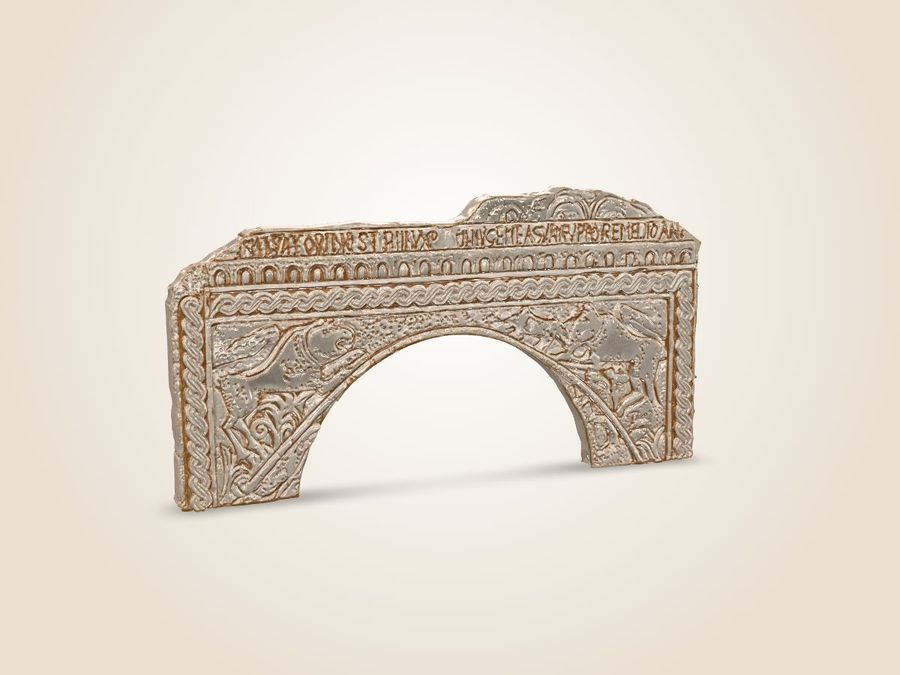
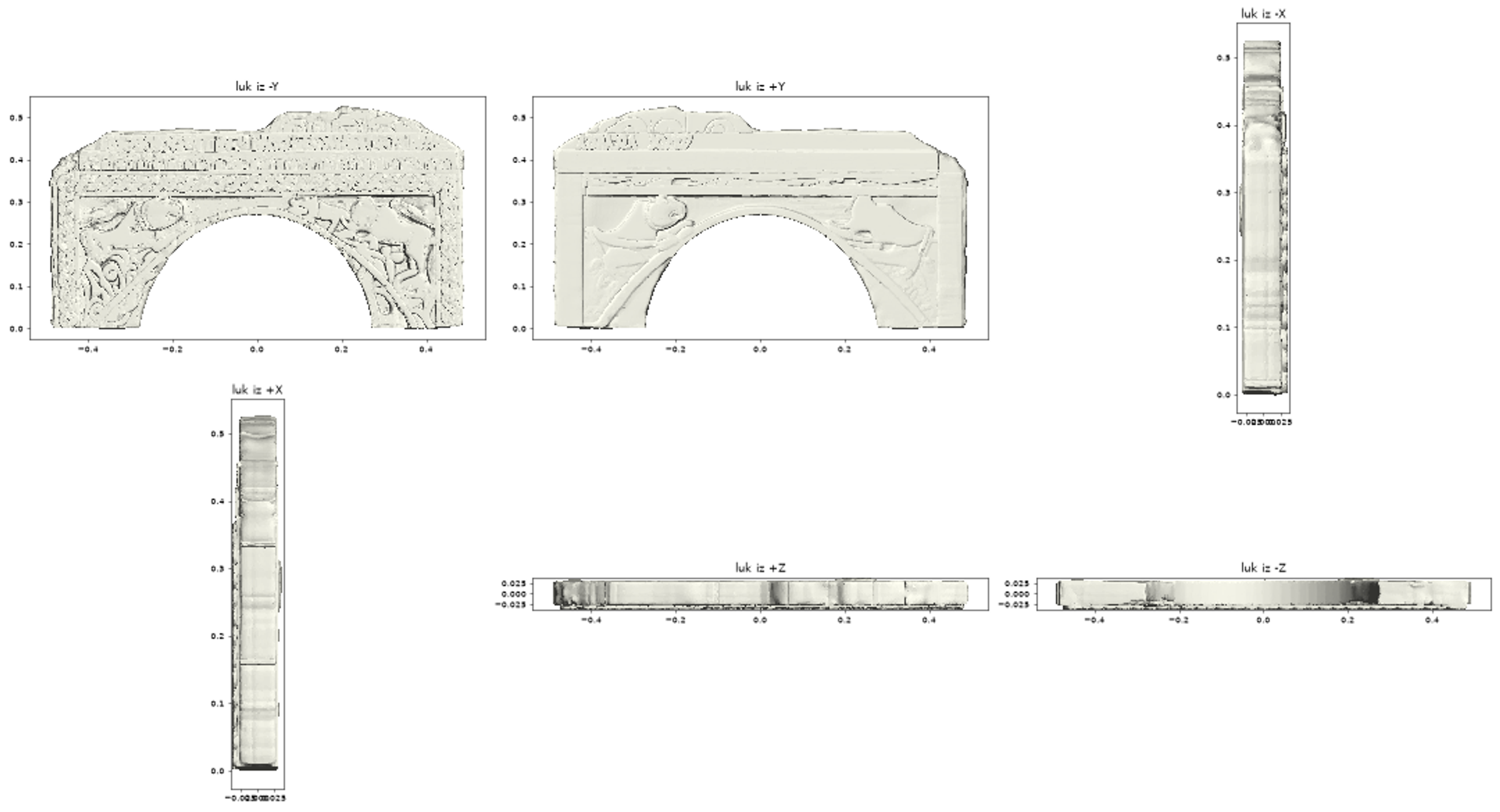
This is **the front side of the Ulcinj ciborium** — the four-arched marble canopy that stood over the altar of a church in the Old Town in the 9th century — and its largest surviving part, the only one on which the whole composition of a side can be seen. The model on this page was reconstructed from photographs, not from a 3D scan.
## What the ciborium was for
A ciborium is a stone canopy over the altar: arches on columns cover the altar and set it apart as the centre of the church. The Ulcinj ciborium also carried a dedication — according to the reconstruction of the inscription, it was dedicated to **Christ the Saviour**. [1]
It was also a votive gift. It was erected by **a woman named Guzma**, pro remedio animae — for the salvation of her soul; her husband, whose name cannot be read on the surviving fragments, carried out her wish. The inscription also names two emperors, Leo and Constantine; by them the ciborium is dated to **813–820**, while more recent interpretations also allow 720–741. [2]
## Church and workshop
It is not certain which church in Ulcinj the ciborium belonged to; it is thought to come from a single-nave early medieval church above the southern town gate, on whose site a new church was built in the 13th century, later destroyed under Ottoman rule. [3] The ciborium was of **marble**; it is thought to be the work of the Kotor stonemasons' workshop, made shortly after the younger ciborium of the Cathedral of St Tryphon in Kotor, after 809. It was later broken up, and its fragments were built into several buildings of the Old Town as building stone. [4] Its closest relatives are the ciboria of Kotor, Komolac and Dubrovnik. [5]
## Lions, arch and inscription
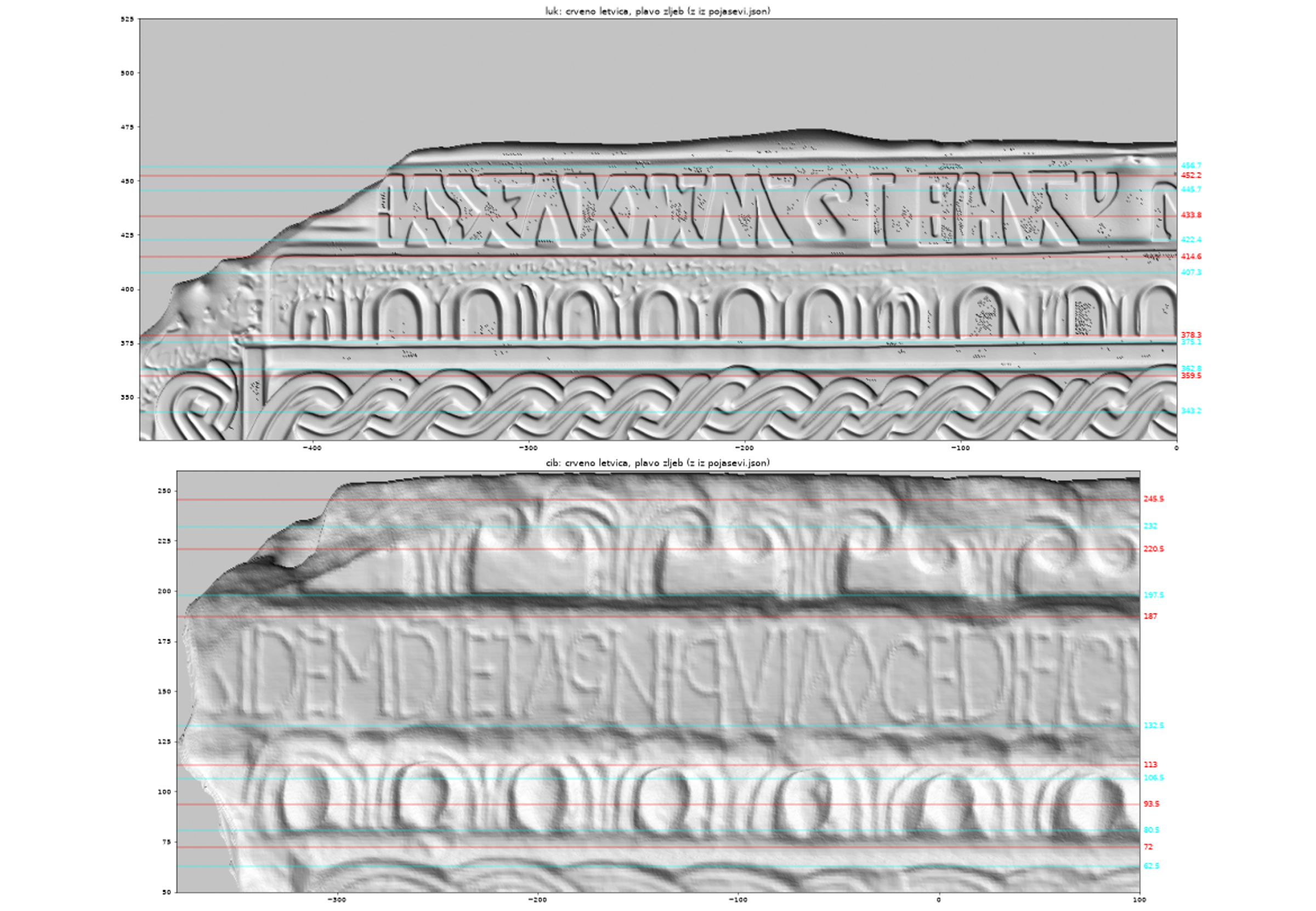
In the two triangular fields above the arch **stand two lions** facing each other; the right one chases a smaller animal. The arch is decorated with an interlaced triple band, and the panel is framed by a three-strand plait with "eyelets". Along the cornice runs a frieze of ovolos and small arches, with the inscription above it, carved in rustic capitals without spaces between words; only part of it survives on this side. [6]
## From Ulcinj to Belgrade
Around 1937 this side was taken from Ulcinj to the **National Museum in Belgrade**, where it is still kept. The other surviving fragments are in the Museum of Ulcinj; one of them, a part of the cornice with the inscription, was 3D-scanned and is described on the page "Fragment of the Ulcinj ciborium". [7]
## Dimensions
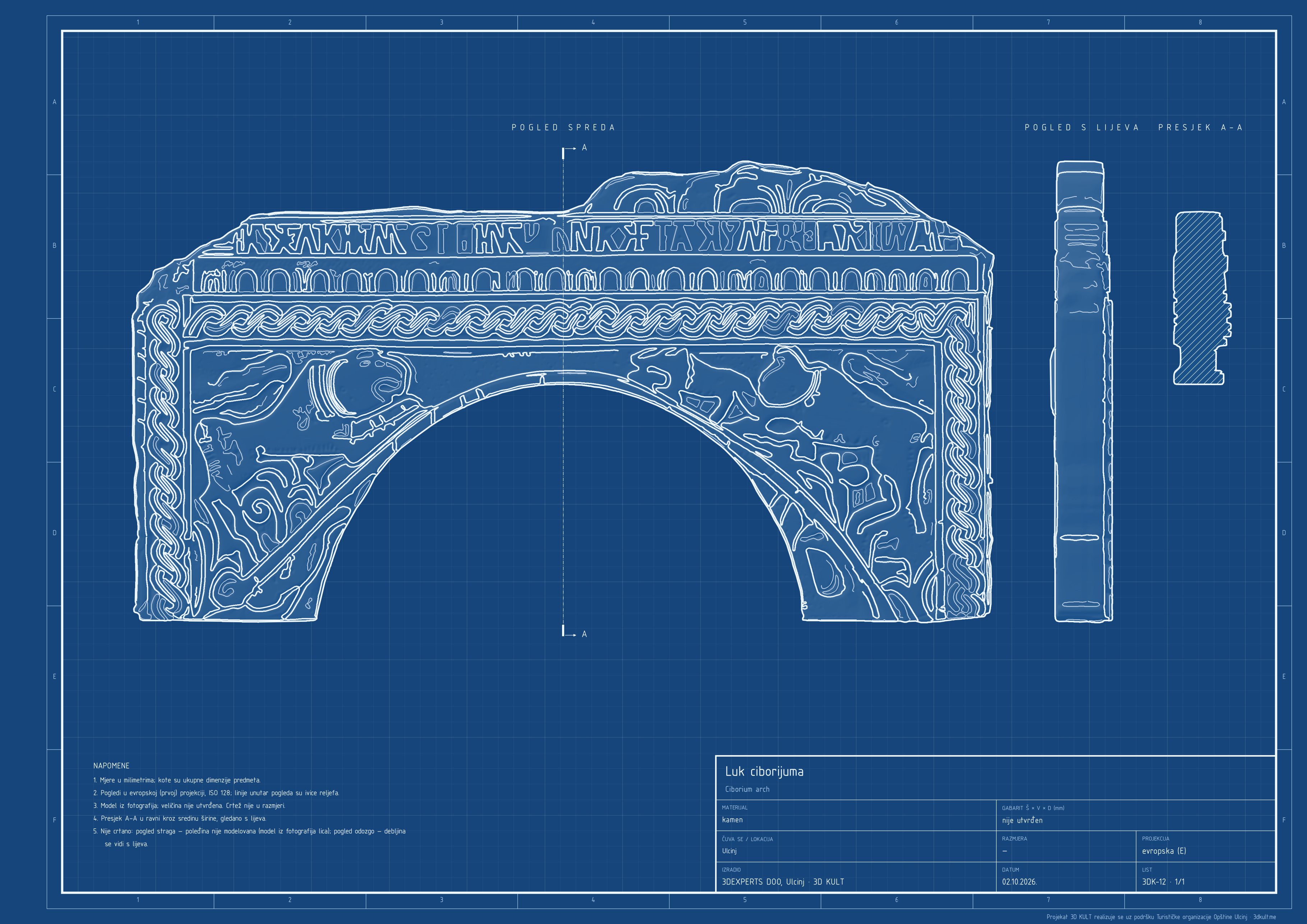
On the published plate of the fragments this side is **about 1.36 m** wide and the panel about 0.68 m high. The arch is a true semicircle with a span of about 0.77 m. [8] The thickness of the panel in Belgrade has not been published; the scanned fragment of the cornice from Ulcinj is 122 mm thick.
## A replica of the whole ciborium
The Ulcinj ciborium can be assembled again as **a true full-size replica** and exhibited in Ulcinj, the town it comes from. This requires 3D scans of the Belgrade side, with the consent of the National Museum of Serbia, and of all the fragments in the Museum of Ulcinj. From the scans every surviving part is made as a faithful copy of the original, in stone or as a cast. What has not survived — the missing parts of the other sides, the columns and the roof — is completed from the fragments and from related ciboria, and remains visibly marked on the replica as a completion. [9]
## The model
**A reconstruction from photographs, not a 3D scan.** The original is in Belgrade and has not been scanned, so the model was made from photographs and may contain errors in shape, ornament and size. The shape and layout of the ornament follow the images, but details of the ornament and the letters are not a copy of the stone, so **the inscription cannot be read from the model**. The back of the model is flat, since the photographs do not show it. An exact model will only come from 3D scanning the original.
Technical drawing
 Open PDF (A3) ↓
Plates from the documentation
Literature and sources
- Narodni muzej Srbije, „Deo ciborijuma iz Ulcinja, IX vek“, objava na zvaničnoj Facebook stranici muzeja — https://www.facebook.com/narodnimuzej/posts/10157807239194646
- T. Koprivica, „Ulcinj, ciborijum“, Leksikon likovne umjetnosti Crne Gore, CANU — https://leks.canu.ac.me/web/llucg.php?OID=3982
- P. Mijović, „Ulcinjski ciborijum“, Starinar n. s. XXXVI (1985), 91–103.
- D. Preradović-Petrović, „Ulcinjski ciborijum – natpis i reljefne predstave“, Godišnjak Pomorskog muzeja u Kotoru L (2002), 247–264.
- I. Stevović, „Emperor in the Altar: An Iconoclastic Era Ciborium from Ulcinj (Montenegro)“, u: Texts – Inscriptions – Images, Art Readings 2016 (ur. E. Moutafov, J. Erdeljan), Sofija 2017, 49–67.
- CANU, Leksikon arheologije Crne Gore, odrednica „Ulcinj“ (M. Vrzić, A. Ljuljđuraj) — https://leks.canu.ac.me/web/arhcg.php?OID=7115
- CANU, Leksikon arheologije Crne Gore, fotografija: „Arkada ulcinjskog ciborijuma, IX v., Narodni muzej Srbije“ — https://leks.canu.ac.me/web/arhcg.php?OID=7115
- CANU, Leksikon arheologije Crne Gore, odrednica „Ciborijum“ (T. Koprivica, A. Ljuljđuraj) — https://leks.canu.ac.me/web/arhcg.php?OID=6669
From the same collection
Fragment of the Ulcinj ciborium
Pre-Romanesque, 9th century: 813–820 (by the emperors named in the inscription)
Fragment of a decorative doorframe
13th century (P. Mijović)