Bronze axe
Bronzana sjekira
Drag to rotate · pinch to zoom
loads {mb} MBDescription
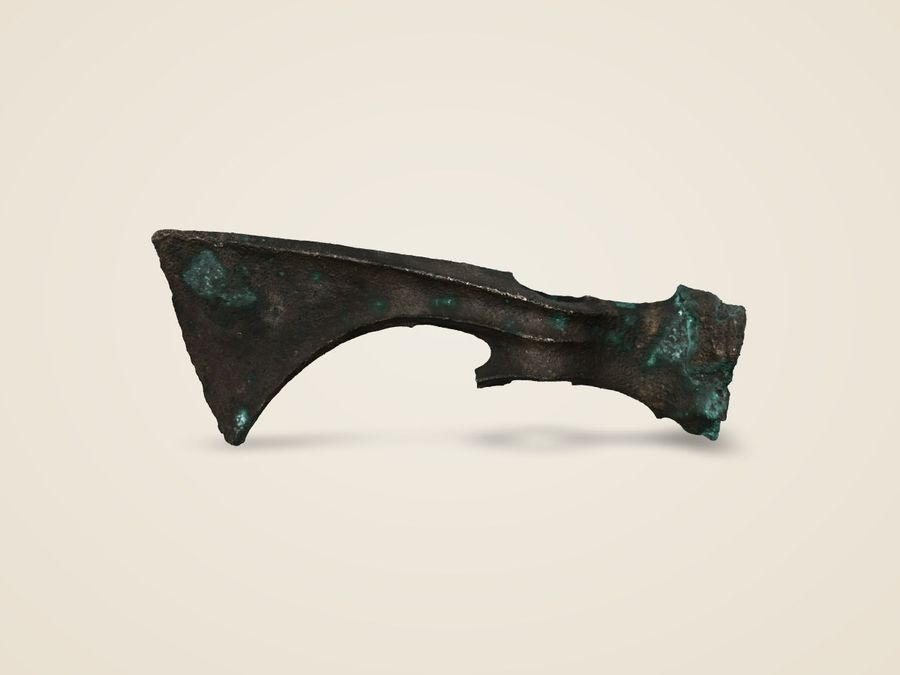
A bronze axe head **with an eye** — the opening for the haft. The blade flares out and extends downwards, while the body narrows towards the eye. The surface shows traces of corrosion, including **green patina**.
This object is published in the **Lexicon of the Archaeology of Montenegro** of the Montenegrin Academy of Sciences and Arts, captioned “Bronze axe of the Albanian-Montenegrin type, 12th–10th century BC, Ulcinj Local Museum”, and described as **a bronze axe of the Late Bronze Age**, a chance find from the wider area of Ulcinj. [1] That this is the same specimen can be seen in the Lexicon's photograph: the same patches of green patina and the same outline of eye and blade. The metal was not analysed for this project; material and date are given after the Lexicon.
## The Albanian-Montenegrin type
Axes of this type are spread across present-day Albania, Bosnia and Herzegovina, Montenegro, Croatia and southern Italy, and are densest **between Albania and Montenegro**, which is why their workshop is sought there. The only securely attested hoard from Montenegro, from Kufin, found by chance in the 19th century and now scattered among museums from Dubrovnik to Vienna, held 20 axes, most of this type, by which it is dated to **the 12th–10th century BC**. Single axes of the same type are known from Kotor, from near Vladimir, from Petrovići (Crvena stijena), Donja Bijela near Nikšić, Kulin in Zavrh, the Kolašin area and Ostrelj near Bijelo Polje. [2]
In its entry on the fortress of Oblik, on Vladimir hill, the Lexicon records that an axe of this type was found in the village of **Suma** below the hill. [3] Whether that is the Ulcinj specimen the Lexicon does not say, and we have not seen the museum records. After the prehistoric figurine, the axe is **the oldest object in this collection**.
## 3D scan
The object was recorded by contact-free 3D scanning. The source model has **2.9 million triangles**, with an average triangle edge of about **0.18 mm**: the finest measure of shape the model retains. The surface colour was captured in an 8,192 × 8,192 pixel texture, about 30.2 pixels per millimetre of surface. The mesh is closed, so both its surface area, 412.1 cm², and its volume, 156.7 cm³, were measured. For the web the model was reduced to 150,000 triangles and a 2,048-pixel texture; the source scan is kept for documentation, technical drawings and printing replicas.
Technical drawing
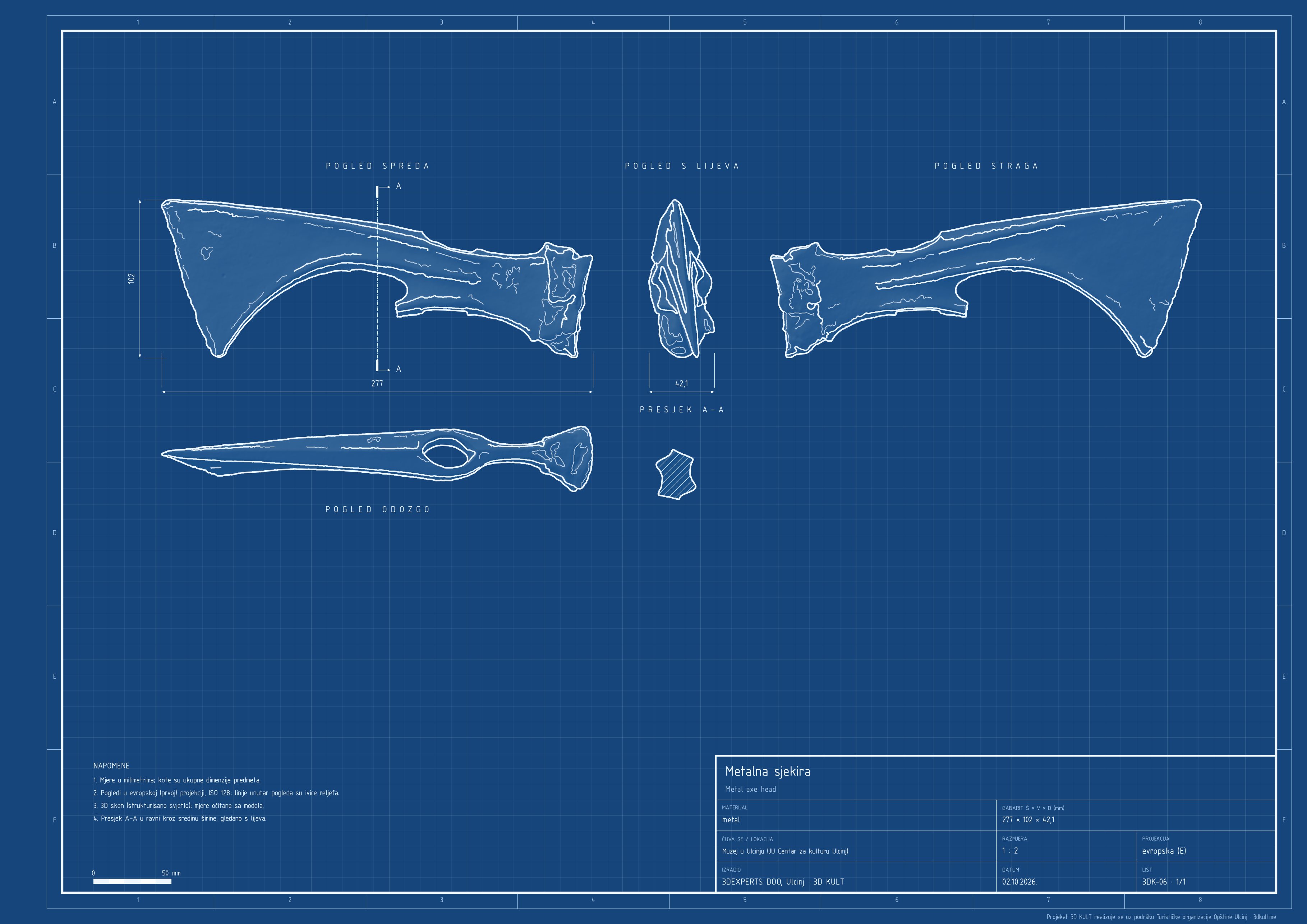 Open PDF (A3) ↓
Literature and sources
- CANU, Leksikon arheologije Crne Gore, odrednica „Ulcinj“ (M. Vrzić, A. Ljuljđuraj) — https://leks.canu.ac.me/web/arhcg.php?OID=7115
- CANU, Leksikon arheologije Crne Gore, fotografija sjekire — https://leks.canu.ac.me/web/Slike/Fig-ARHCG-7115-7300.jpg
- CANU, Leksikon arheologije Crne Gore, odrednica „Ostava“ (M. Blečić Kavur) — https://leks.canu.ac.me/web/arhcg.php?OID=6921
- CANU, Leksikon arheologije Crne Gore, odrednica „Oblik“ (M. Cerović) — https://leks.canu.ac.me/web/arhcg.php?OID=8525
- P. Mijović, „Bojne i radne sjekire kasnog bronzanog doba iz Crne Gore i sjeverne Albanije“, Zbornik radova Muzeja rudarstva i metalurgije Bor 3–4, 1980, 61–104.
- M. Blečić Kavur, D. Medin, „Izgubljene u prijevodima: sjekire albano-crnogorskog tipa s Kufina“, Konteksti kulture: studije iz humanistike i umjetnosti II, 2024, 15–41.